
If you are not following AI
every day, begin here.
Boiling Frogs exists to make AI change easier to see before it becomes impossible to ignore.

Artificial intelligence is no longer just a specialist technology story. It is becoming part of everyday tools, workplaces, classrooms, creative systems, public debate, and decision-making.
Most people do not have time to follow every model launch, product demo, research paper, investor claim, or policy announcement. That does not mean they can afford to ignore the direction of travel. Boiling Frogs is for readers who want enough context to understand what is changing, ask better questions, and avoid being caught by surprise.
The promise: plain-English AI awareness for people who are busy, curious, sceptical of hype, and aware that the ground is moving.
Three signals that show why this primer matters now.
Start Here should not feel like a museum label. These are the kinds of live signals Boiling Frogs translates: safety tests before launch, quiet workplace rewiring, and the physical infrastructure behind a simple answer.
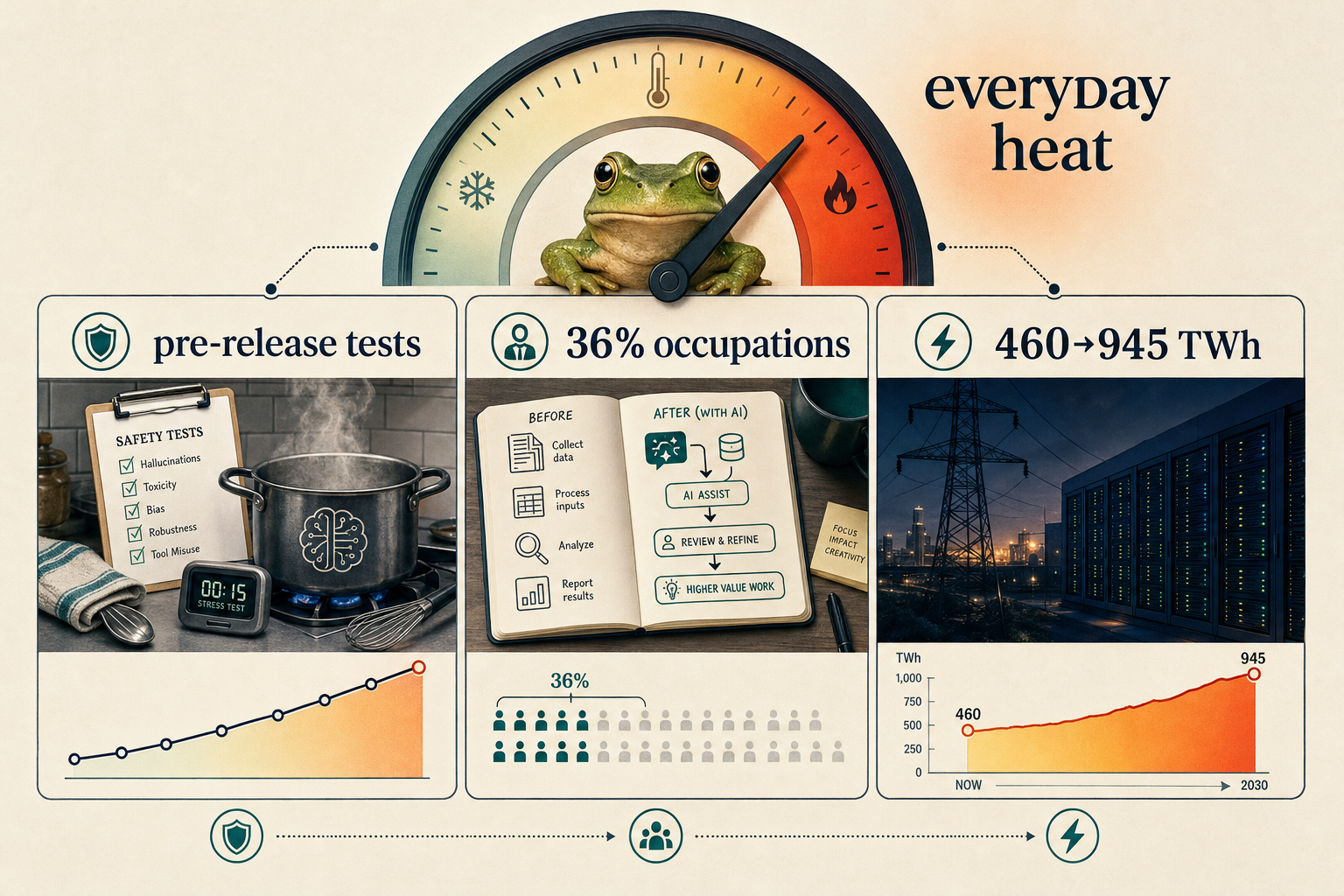
pre-release frontier-model tests
AI safety is moving into the test kitchen before launch — useful, but only if readers ask what was actually inspected.
For a school or council, “evaluated” should start a checklist, not end the conversation. NIST / CAISI · May 202636% of occupations touched
The water warms task by task: drafts, summaries, comparisons, support replies and first-pass analysis move before job titles change.
In an office, the visible sign may be a polished 9am report, not a dramatic automation announcement. Anthropic Economic Index · 2025460 → 945 TWh data-centre demand signal
The answer box looks weightless; the hidden machine is chips, cooling, grid pressure, water and platform contracts.
A “free” AI summary can still become a local electricity bill or a dependency on rented intelligence. IEA Energy and AI · 2025The four questions we keep asking
Every Boiling Frogs briefing is shaped by four practical questions:
- What changed? The development or trend in plain English.
- Why does it matter? The social, economic, educational, or personal implications.
- Who is affected? Workers, families, schools, leaders, creators, citizens, or institutions.
- What should readers watch next? The signals that show whether a change is becoming important.
What AI change looks like in everyday life
AI rarely arrives as a single dramatic event. It shows up as a new writing assistant in office software, an automated note-taker in meetings, a chatbot in customer service, a search result that gives answers instead of links, a homework tool, a hiring filter, a synthetic image, or an agent that can operate a browser.
Each change may feel manageable on its own. The bigger shift is cumulative: more decisions, drafts, recommendations, summaries, and actions are being mediated by systems that most people do not fully understand.
AI change usually climbs five quiet steps.
Use this ladder to turn a vague feeling — “AI is everywhere now” — into a practical diagnosis of where the heat is rising in a school, team, household or service.
1 Tool appears cool surface
A writing helper, image generator or meeting summariser is added to software you already use.
Who can turn it on, and what data does it see?2 Habit forms warm edges
People stop saying “I used AI” because drafting, rephrasing and summarising become background behaviour.
Which tasks would now feel slow without it?3 Workflow bends visible ripples
The same job title stays in place, but first drafts, support triage, candidate screens and analysis loops move through AI.
Where is human review real, and where is it rubber-stamping?4 Institution depends steam rising
Schools, teams and services build policies, budgets and expectations around AI-assisted output.
What fails if the system is wrong, unavailable or quietly optimised for someone else?5 Normal has moved new waterline
People call the old way inefficient, even if the new way is less transparent, less private or harder to challenge.
What did we accept before we consciously chose it?Grounding signal: Stanford HAI reports 78% of organisations used AI in 2024, while Anthropic’s Economic Index shows workplace adoption spreading task by task — the ladder helps readers see what those numbers feel like in daily life.
Four places to notice the temperature rising this week.
Use these as a quick household or workplace radar. The point is not to panic; it is to notice where “normal” is quietly being rewritten.
01Inbox
A colleague’s email arrives unusually polished, already summarising three threads you never saw.
Ask: what was drafted, summarised or prioritised before a human reviewed it?02Classroom
Homework becomes easier to generate than to verify; effort is harder to see from the final document.
Ask: can the student explain the sources, method and trade-offs in their own words?03Hiring desk
CVs, cover letters and first-pass screens are all partly automated, making “human judgement” less visible.
Ask: where is AI ranking, filtering or rewriting the applicant before the interview?04Search and media
An answer box or plausible clip feels complete, even when the source trail is thin or synthetic.
Ask: what would change my mind, and can I find the original evidence?Try the “normality diary” before reading another AI headline.
For one ordinary week, track where AI changes the first draft, evidence trail, decision route or hidden bill. The site becomes more useful when the reader can recognise the heat in a real Monday morning, not only in a lab announcement.
Monday Work inbox
A meeting summary, reply draft and priority list appear before anyone says “AI”.
Anthropic Economic Index: workplace use spreads through tasks, not job-title headlines. Circle the hand-off: where did the system draft, rank or summarise before a person approved it?Tuesday Search result
The answer box feels complete enough that nobody clicks through to the original source.
Boiling Frogs answer-layer briefing: convenience can hide the evidence trail. Ask what proof would change your mind and whether the source trail is still visible.Wednesday Schoolwork
A polished first draft arrives faster than a teacher, parent or student can verify the reasoning.
Boiling Frogs AI-literacy guide: the bottleneck moves from producing text to checking understanding. Ask the learner to explain sources, method and trade-offs without the generated paragraph.Thursday Public service or support queue
The bot does not just answer; it triages, escalates and writes the next human response.
Agent permission-chain briefing: tool-use systems change who acts and who checks. Find the appeal route. If the automated step is wrong, who can see and reverse it?Friday Power and infrastructure
A “free” AI answer points back to chips, cooling, electricity, water and cloud contracts.
IEA Energy and AI 2025: data-centre electricity demand could roughly double by 2030. Translate magic into plumbing: who pays the bill, who owns the pipes, and who controls access?How to read Boiling Frogs
- Start with the boiling frog problem to understand why gradual change can feel sudden.
- Read about AI agents to see why the next phase is about systems that can act, not only answer.
- Read the work briefing to understand why tasks often change before whole jobs do.
- Use the AI literacy guide as a practical checklist for families, schools, and organisations.
- Consider the Kindle briefing if you want a short, structured overview in one sitting.
What Boiling Frogs is not
- It is not a daily product-news feed.
- It is not a technical research journal.
- It is not a place for blind optimism or doom-laden panic.
- It is not advice to adopt every new tool immediately.
The goal is awareness: enough understanding to notice when the temperature changes, enough scepticism to question easy claims, and enough confidence to take part in conversations that increasingly affect everyone.