The announcement
A lab, regulator or platform says the next model is safer, faster or more capable.
Do not stop at the claim. Ask what changed in scope, access or cost.
A short, accessible Kindle briefing for readers who can feel the water warming but have not had time to follow every model launch, boardroom memo, school argument or deepfake headline.
Think of it as the map before the headlines: why the race accelerated, why agents matter, and why the change is showing up first in ordinary tools — inboxes, homework, hiring filters, support chats, search results and creative work.
AI change is not arriving as one dramatic event. It is arriving as small upgrades to tools people already trust. The book gives non-specialists a way to spot the pattern before it hardens into normality.
No coding or machine-learning background required. The book is written as a first orientation for general readers who want the shape of the story, not a glossary dump.
Looks across work, creativity, social trust, education, power, and institutions rather than treating AI as only a gadget story.
The tone is calm but direct: enough context to think clearly without hype, denial, or panic.
The publication page now connects the Kindle briefing to the same live temperature signals the site tracks: safety testing, workplace task creep and AI’s physical infrastructure. Each bar is a plain-English heat cue, not a prediction machine.
Treat “evaluated” like a kitchen inspection: useful evidence, not a guarantee that every classroom, council service or family phone is safe by default.
Anthropic Economic Index · 2025The first visible change is often a faster draft, summary or shortlist — not a dramatic announcement that a whole job disappeared.
IEA Energy and AI · 2025A simple AI answer sits on chips, cooling, electricity, water and cloud contracts. The book helps readers see the pipes behind the magic.
The book explains the pattern underneath the current news: AI first appears as a feature, then rearranges a workflow, then becomes a default, then reveals the infrastructure and governance bill underneath.
Analogy: Like asking to see the kitchen before the restaurant opens — useful, but only if you know which cupboards were inspected.
Real-world question: Parents, headteachers and managers should translate “evaluated” into: evaluated for what, by whom, and in whose setting?
Anthropic Economic Index · 2025Analogy: Not a robot taking the desk — invisible first-draft assistants appearing in the workflow one drawer at a time.
Real-world question: The book’s practical lens is to map the handoff: draft, rank, summarise, recommend, approve, escalate.
IEA Energy and AI · 2025Analogy: The chatbot is the tap; data centres, chips, power contracts and cooling are the plumbing behind the wall.
Real-world question: Readers can ask who pays the local bill when intelligence becomes rented infrastructure rather than a standalone app.
This new relay turns the Kindle page into a more active preview of the reading experience: headline → wrapper → habit → bill. It gives visitors a practical way to use the book against the next AI news cycle, not just the last one.
A lab, regulator or platform says the next model is safer, faster or more capable.
Do not stop at the claim. Ask what changed in scope, access or cost.The model becomes a button inside search, office software, school tools, support systems or creative apps.
Look for the permission layer: what can it read, write, rank, send or remember?People begin using it for the first draft, shortlist, summary, image, answer or next action.
Map the hand-off before debating the headline: who checks the output and who signs off?The invisible parts appear: compute, energy, data, training, defaults, governance and dependency.
Follow the plumbing behind the magic: who pays, who controls, and what becomes hard to reverse?The point is not to memorise model names. It is to notice where ordinary life is being rewired task by task.
Which parts of your job are quietly becoming prompts, approvals or exceptions?
What counts as learning when the first draft is no longer scarce?
How do families and leaders rebuild trust when screens become too fluent?
Who gets to steer the models that millions of people will depend on?
This adds a more visual “how the briefing works” layer: the book is not asking readers to chase every launch. It helps them follow the heat from the front page to the place it will actually land.
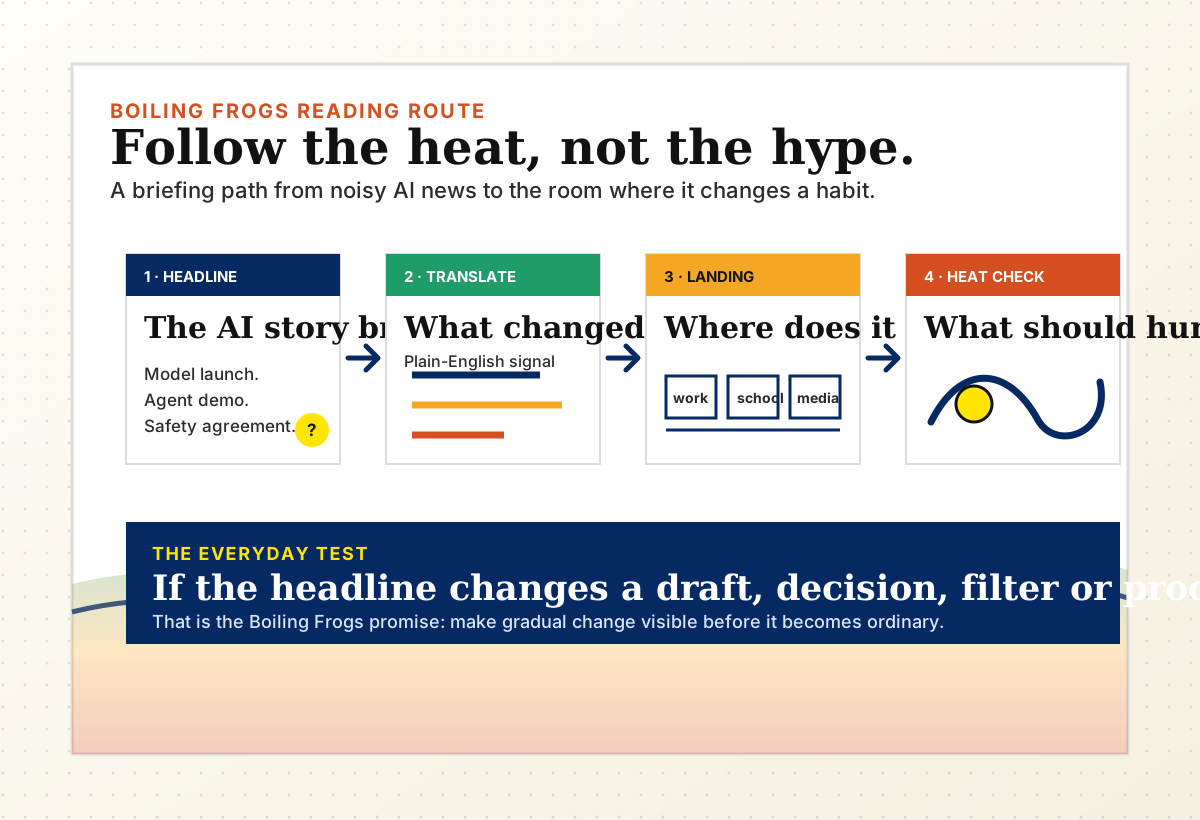
The book starts with the noisy layer: models, agents, safety tests, investment and synthetic media.
Each chapter asks what the development changes in ordinary language, not in lab shorthand.
Readers see the route into inboxes, classrooms, hiring desks, support queues, search and creative tools.
Who checked it, who benefits, what became default, and what should a human still decide?
The publication lane can grow into short reports, printable briefings, reading lists, and topic guides for parents, leaders, teachers, and general readers.