
The workplace AI thermostat: when optional tools become expected habits
A sourced briefing on how AI use at work moves from experiment to expectation — and what employees, managers and families should watch before the new normal locks in.
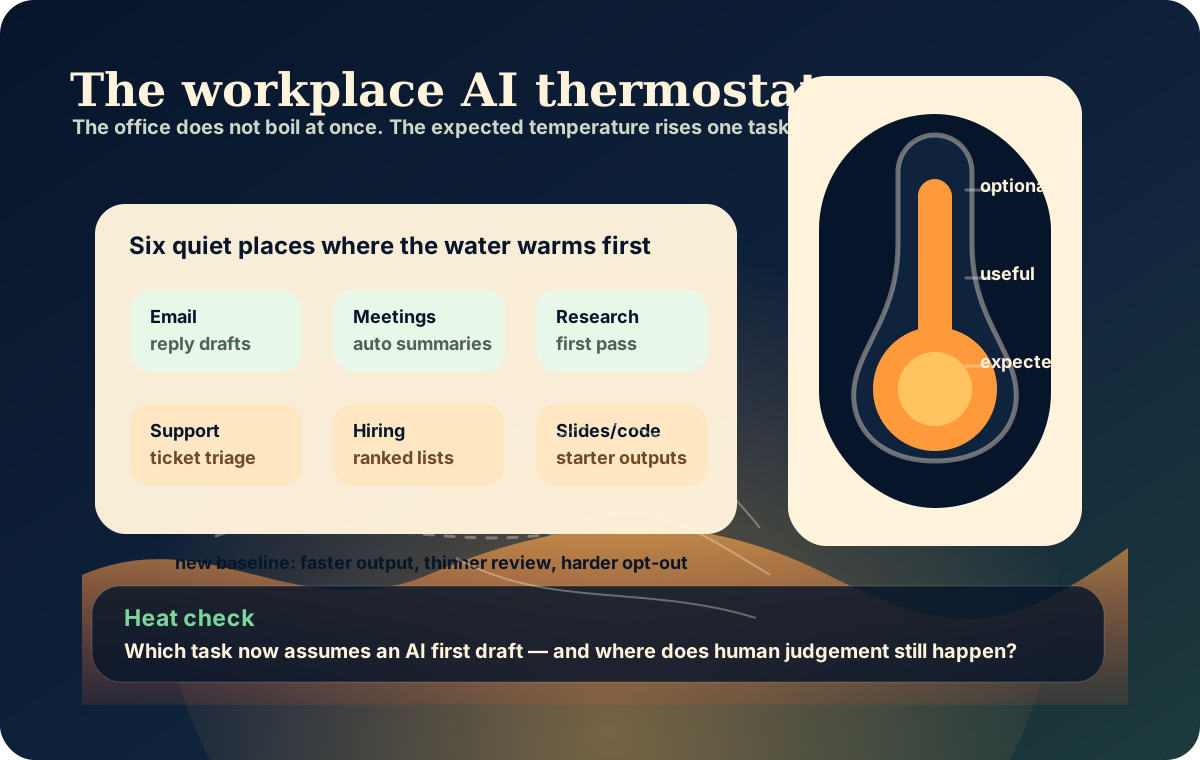
AI adoption becomes harder to see when it spreads through small office tasks rather than job-title changes.
Track which tasks now assume an AI first draft, where review thins out and what habit would be hard to reverse in six months.
AI at work rarely arrives with a brass band. It arrives as a small convenience: summarise the meeting, rewrite the email, clean the spreadsheet, draft the policy note, compare the contract, generate the first slide.
That is the thermostat problem. The office does not suddenly boil. The default temperature rises one task at a time until the old way starts to feel strangely slow.
The signal
The broad direction is no longer speculative. Stanford HAI’s 2025 AI Index reported that 78% of organisations said they used AI in 2024, up from 55% the year before. Anthropic’s Economic Index found AI use across a wide spread of jobs, with roughly 36% of occupations showing AI use in at least a quarter of tasks. Its later September 2025 report said 40% of U.S. employees reported using AI at work, up from 20% in 2023.
The everyday translation is simple: AI is no longer just a tool for the technical team. It is moving into the shared office climate.
Why this matters in ordinary rooms
A worker may not think they are “using AI” when they accept a suggested email reply, ask a document tool for a summary or let a meeting app produce action points. A manager may not call it automation when a team uses AI to draft customer notes, produce first-pass research or rank incoming support tickets.
But those small uses change expectations:
- the quick first draft becomes the baseline;
- the person who reads every document manually looks slower;
- the meeting without an automated summary feels unfinished;
- the customer-support queue expects instant triage;
- the hiring desk expects ranked shortlists;
- the school or council office starts to treat AI-written text as normal paperwork.
The heat is not only job loss. The quieter heat is pace, proof and pressure: pace because the expected turnaround shortens, proof because people must show their judgement rather than merely produce output, pressure because opting out can look like falling behind.
The thermostat has three dials
1. Task spread
Watch how many small tasks get AI assistance before anyone redesigns the job title. If the tool is used for email, notes, research, slides, coding, forms and customer replies, the role has already changed even if the contract has not.
The everyday question: which parts of the job now assume an AI first draft?
2. Approval depth
AI can help by preparing work for a human to review. It can also quietly thin the review layer if people only skim the output because the queue is moving faster.
The everyday question: where does a human still check the reasoning, not just tidy the wording?
3. Skill transfer
If junior workers use AI to produce polished outputs without seeing the messy middle, they may learn less about how good judgement is built. The same risk appears in schools, apprenticeships and professional training.
The everyday question: what practice disappears when the draft arrives already smoothed?
A practical heat check for teams
Before buying another AI work tool, ask four plain questions:
- What task is warming? Name the exact work, not the vague promise.
- Who becomes faster — and who becomes easier to monitor? Productivity tools often double as visibility tools.
- What mistake would be hard to notice? A confident summary, ranking or recommendation can hide what it left out.
- What habit would be hard to reverse in six months? The new normal matters more than the launch demo.
The boiling-frog lesson is not “avoid AI at work”. It is that adoption and understanding should rise together. If the office thermostat goes up, people deserve to know which tasks warmed, who controls the setting, and where the human judgement still lives.