
The model leaderboard needs a reader receipt
AI model rankings change too fast to read as a single winner list. The useful question is what task was tested, what source backs it, what it costs, and where a human will meet the result.
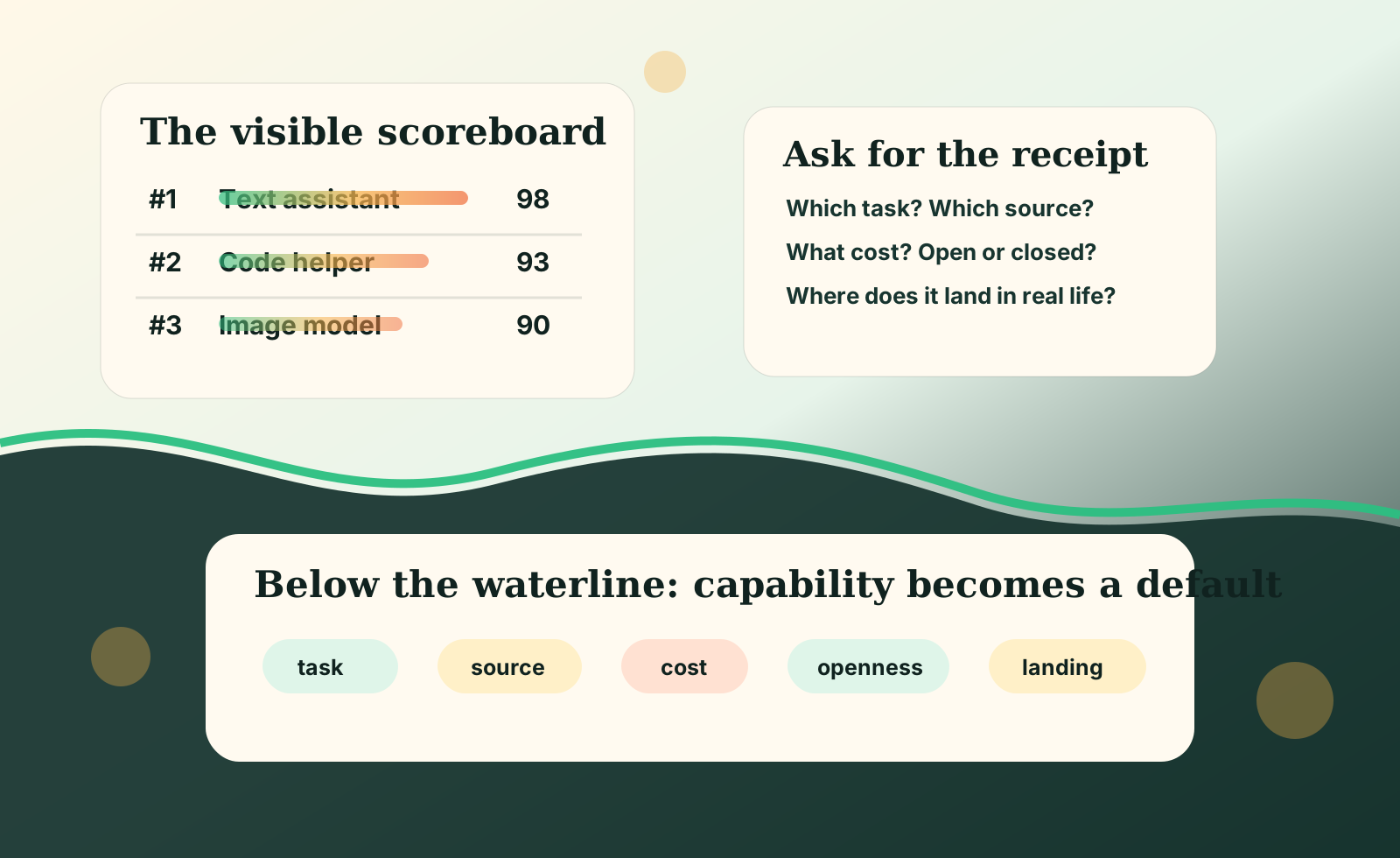
Model rankings are useful only when readers can see the task, benchmark source, cost, openness and downstream setting behind the score.
When a tool claims to use the best model, ask which job it was tested on and where the result lands: inbox, classroom, support queue, codebase or image feed.
A model leaderboard can look like a horse race: one name at the top, a few arrows, a neat score, a temptation to ask which AI is “best”.
That is the wrong first question.
A better question is: best for which job, measured by whom, at what cost, with what evidence trail, and with what human consequence?
Boiling Frogs now treats model rankings as a reader receipt, not a trophy shelf. The point is not to memorise every model name. The point is to notice how quickly the background layer of everyday software is being rearranged.
The scoreboard is heating the water
The new Model Watch board tracks five practical task lanes: general text, coding, creative writing, computer use and image generation. Its current data file was refreshed on 13 June 2026 and catalogues 32 public benchmark or leaderboard sources across those task types.
That matters because one big AI name no longer tells the whole story. A model can be strong at coding and less useful for writing. Another can win a chat preference board while being expensive, closed, hard to audit or unsuitable for a school, council or small business workflow.
Think of the leaderboard like a restaurant review pinned to a kitchen door. Useful, but incomplete. You still want to know what dish was tested, whether the kitchen is open to inspection, who pays the bill and whether the meal is being served to children, workers, customers or citizens.
Four columns to read before the rank
When a model board appears in a product pitch, procurement deck or news story, do not stop at the number. Read the receipt.
| Receipt line | What it means in plain English | Everyday translation |
|---|---|---|
| Task | Which kind of work was actually measured? | Writing a school policy is not the same as generating code or controlling a browser. |
| Source | Which benchmark, arena or public board backs the claim? | ”Top model” should come with a route back to the scoreboard, not only a marketing slide. |
| Cost | What does each answer, image or workflow actually cost at scale? | A cheap demo can become a monthly infrastructure habit when every team adopts it. |
| Openness | Can outsiders inspect, host or challenge the system? | Closed systems may be convenient; open-weight systems may give more local control but still need skill and infrastructure. |
The rank is a headline. The receipt is the governance story.
Why this is not just for AI people
Most readers will never choose a foundation model directly. They will meet the choice downstream: the search box that answers first, the workplace assistant that drafts before the employee, the design tool that generates the image, the browser agent that clicks, the school product that marks or summarises student work.
That is why model rankings need ordinary-language translation. They decide which capabilities become cheap, default and expected.
If the best coding model suddenly gets cheaper, more teams automate code review and bug fixing. If image generation quality jumps, synthetic media becomes easier to produce and harder to dismiss. If computer-use models improve, the question moves from “what did it say?” to “what did it do inside my apps?”
The practical reader test
Next time a model leaderboard is used as evidence, ask five questions before trusting the heat:
- Which task lane is this? Text, code, writing, image, browser use or something else?
- Which sources agree? One benchmark can be useful; several task-relevant boards are stronger.
- Is the model open, closed or only available through a platform? That changes control, audit and dependency.
- What is the cost at normal use, not demo use? Cheap prompts can become expensive habits when embedded everywhere.
- Where will a non-expert meet this model? In a classroom, inbox, support queue, search answer, design brief or government service?
This turns the AI horse race into a household and workplace checklist.
Boiling Frogs lens: the model name is the splash. The receipt is the waterline: task, source, cost, openness and the ordinary room where the capability lands.
Sources: Boiling Frogs Model Watch, Artificial Analysis LLM Leaderboard, LMArena leaderboard, LiveBench, Stanford HELM Lite.