
The AI warranty receipt: what is promised after the shortcut ships?
A plain-English briefing for checking what support, limits and repair promises come with an AI feature once it becomes part of ordinary work.
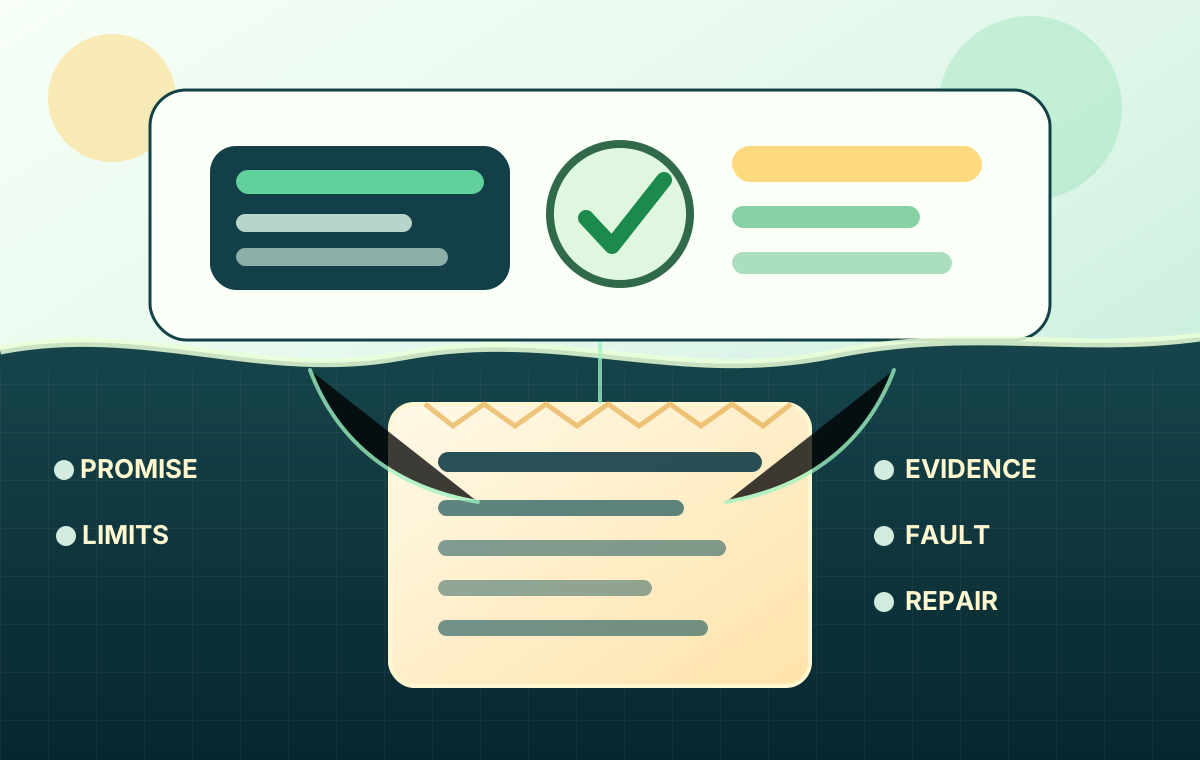
AI shortcuts become harder to govern when they ship into routine work with no plain-English promise about limits, monitoring, support and repair.
Before accepting an AI feature as normal infrastructure, ask what job is promised, what is excluded, what evidence survives, what signals faults and who repairs harm.
AI products often arrive like a new appliance: shiny demo, simple button, confident promise. The sales story is about what it can do today. The harder question is what happens after it is installed.
A meeting summariser can become the office memory. A support copilot can shape replies. A model dashboard can steer procurement. A school tool can flag work. A public-service triage system can route cases. Once the shortcut becomes normal infrastructure, people need more than a feature list. They need to know the warranty.
An AI warranty receipt is the visible promise that says what the tool is meant to do, what it does not cover, what evidence should travel with it, how faults are reported, and who repairs harm when the shortcut fails.
Why this matters now
AI use is no longer confined to pilots and lab demos. Stanford HAI reported that 78% of organisations used AI in 2024, up from 55% a year earlier. Anthropic’s Economic Index shows AI already touching slices of work across many occupations, often as augmentation rather than full replacement. The International Energy Agency expects data-centre electricity demand to rise from about 460 TWh in 2022 to around 945 TWh by 2030.
Put those signals together and the everyday implication is blunt: AI is becoming installed infrastructure. It is in the office suite, the search layer, the help desk, the classroom workflow, the code tool and the procurement dashboard. Infrastructure needs a warranty because failure does not stay inside the demo.
For non-specialists, the warranty question cuts through the fog. Do not ask only “is this AI powerful?” Ask “what exactly is promised, what is excluded, how will I know if it drifts, and who fixes the damage?”
The washing-machine analogy
When you buy a washing machine, the warranty is not the glossy photo on the box. It is the boring but crucial promise underneath: what parts are covered, what counts as misuse, how long support lasts, who repairs it, and what evidence you need when it breaks.
AI tools need the same plain-English support label. The product demo is the shiny appliance. The warranty receipt is the document stuck to the inside of the cupboard: model version, data limits, allowed use, monitoring signal, escalation route, repair owner.
Without that receipt, every failure can become a blame carousel: the vendor says the model behaved as designed, the organisation says the user should have checked, the user says the system looked official, and the affected person is left cleaning up the spill.
The five-line warranty receipt
Use this receipt when an AI feature becomes part of a routine workflow:
- Promised job: what task is the AI actually warrantied to help with: draft, summarise, rank, search, flag, route, code, recommend or act?
- Coverage limits: which users, data, languages, cases, dates, risk levels or deployment settings are outside the promise?
- Evidence kept: what source bundle, model/tool label, prompt/context, date stamp and human decision trail survive after output is used?
- Fault signal: what alerts people that the shortcut may be wrong, stale, biased, incomplete, overconfident or out of policy?
- Repair owner: who corrects the record, notifies affected people, changes the workflow and pays the attention cost when the warranty fails?
Where to look first
The warranty receipt is most useful where a polished AI output can quietly become the thing other people rely on:
- Workplace suites: what support promise covers AI meeting notes, email drafts, spreadsheet answers and slide summaries once they become the shared record?
- Customer support: when a suggested answer closes a case, what counts as a fault and who reopens the repair loop?
- Schools and hiring: if a flag, score or feedback note travels forward, what evidence and appeal path come with it?
- Search and research tools: what freshness, source and citation limits are promised before an answer is reused in a report?
- Model dashboards and procurement: if a ranking steers a purchase, what deployment setting was the score warrantied for?
The practical habit is simple: when an AI shortcut is sold as ready for normal use, ask for the warranty receipt before the output becomes someone else’s record.
Boiling Frogs lens: consequential AI needs a warranty receipt: promised job, coverage limits, evidence kept, fault signal and repair owner.
Sources: Stanford HAI AI Index 2025, Anthropic Economic Index, IEA Energy and AI, NIST AI Risk Management Framework.