
The AI verification receipt: can anyone replay the answer?
A plain-English briefing for checking whether a polished AI answer, score or recommendation can be traced, replayed and challenged before people rely on it.
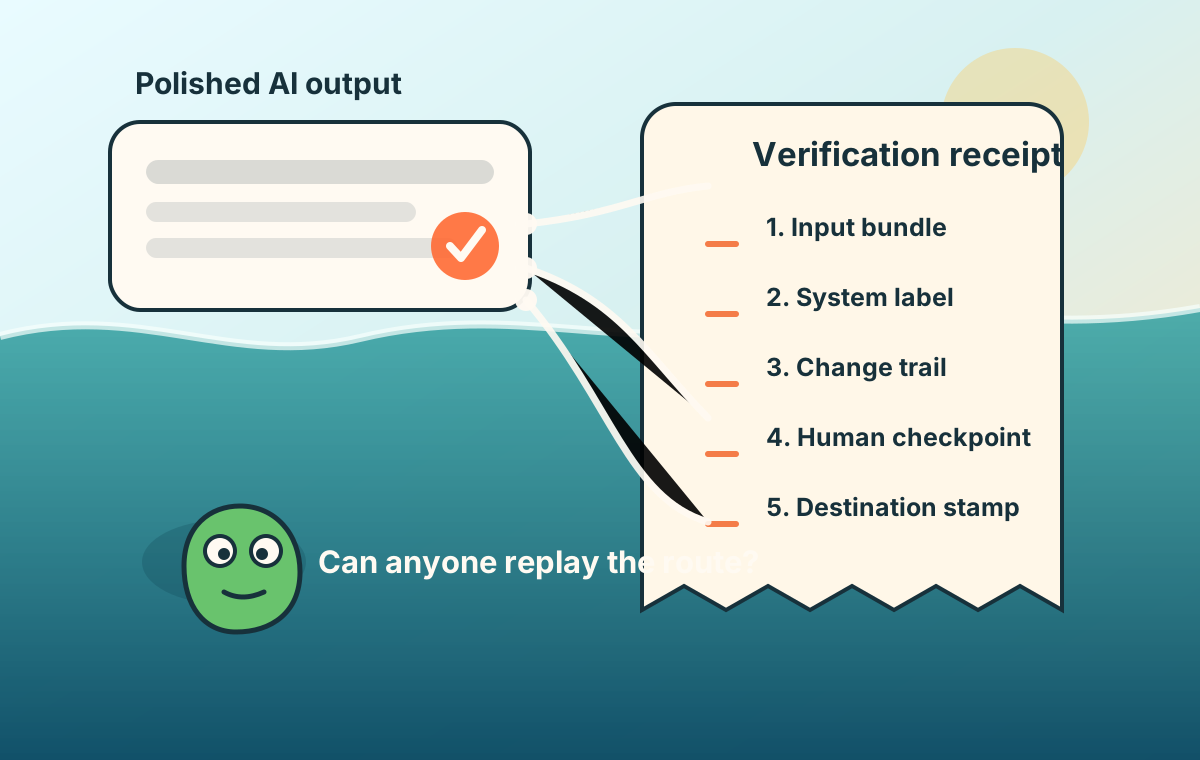
AI outputs become harder to trust when the answer, score or recommendation travels faster than the source trail people need to replay it.
Before relying on an AI-shaped output, ask what it saw, which system shaped it, what changed, who can inspect it and where it lands next.
The next useful AI question is not only “is this answer good?” It is can anyone replay how we got here?
A meeting assistant produces the recap. A support copilot writes the reply. A search assistant compresses five sources into one answer. A model dashboard says one system is “best”. A school tool suggests feedback. A procurement deck ranks vendors. The output can look neat, fast and sensible — while the path behind it is already disappearing.
That is why ordinary AI literacy now needs an AI verification receipt: a short, visible way to check whether an AI-shaped output can be traced, replayed and challenged before it becomes a record, route, score, purchase or decision.
Why this matters now
Three current signals make verification a practical habit, not a specialist audit exercise:
- AI is entering ordinary task flows. Anthropic’s Economic Index found AI use touching at least a quarter of tasks in 36% of occupations. The everyday translation: verification gaps will appear in normal drafts, summaries, queues and rankings long before they look like dramatic automation.
- Governance guidance keeps emphasising measurement and management. The NIST AI Risk Management Framework asks organisations to govern, map, measure and manage risk. For readers, that becomes a blunt test: can the organisation reconstruct what the system saw, did and changed?
- Higher-stakes AI rules are moving toward documentation. The EU AI Act phases in duties around transparency, risk management, logging and human oversight for higher-risk uses. The plain-English lesson is that “trust us” is not a receipt.
The boiling-frog danger is not that every AI output is false. It is that the output becomes convenient while the evidence trail becomes too thin to inspect.
The everyday analogy
Think of an airport boarding pass.
The pass is useful because it is not just a confident sentence saying “you may fly”. It carries a name, route, time, gate, seat, barcode, issuer and scan trail. If something goes wrong, staff can check the booking, reprint it, redirect the passenger or explain why the gate closed.
AI outputs need the same checkable travel document. Not a hundred-page audit report for every paragraph. A simple receipt showing what evidence entered, which system shaped it, what changed, who checked it and where the result is going next.
The five-line verification receipt
Use this receipt whenever an AI system summarises, scores, ranks, recommends, routes, drafts or records something people may later treat as settled:
| Receipt line | Plain-English test | Reader question |
|---|---|---|
| Input bundle | What did the AI actually see? | Source documents, transcript, search results, database row, image, benchmark, policy or user prompt? |
| System label | Which tool and version shaped it? | Model, product wrapper, retrieval layer, settings, date and any organisation-specific prompt? |
| Change trail | What did the AI transform? | Summary, ranking, score, extraction, translation, classification, recommendation or action? |
| Human checkpoint | Who can inspect or replay it? | Worker, teacher, manager, support lead, procurement owner, caseworker or external reviewer? |
| Destination stamp | Where will it land next? | Customer reply, official record, shortlist, dashboard, school note, public answer, codebase or buying decision? |
The useful test is not whether a system sounds confident. It is whether a competent person can reconstruct the route from source to output.
Where it lands tomorrow
- In search and research tools: a one-paragraph answer should make the source stack visible enough that readers can check what was compressed or skipped.
- In meeting records: a summary that becomes institutional memory should show what transcript, date and human checkpoint stand behind it.
- In support queues: a generated reply should expose the customer evidence and policy snippets used before the answer becomes a permanent case note.
- In schools and hiring: feedback, flags and shortlists should carry enough trail for appeal, correction and context.
- In model dashboards: a ranking should show task, benchmark, date, wrapper, cost and real-world landing place before “best” becomes a shortcut.
The practical habit is simple: before accepting an AI output as finished, ask whether it has a boarding pass.
Boiling Frogs lens: every consequential AI output needs a verification receipt: input bundle, system label, change trail, human checkpoint and destination stamp.
Sources: Anthropic Economic Index, NIST AI Risk Management Framework, EU AI Act overview.