
The AI sign-off receipt: who puts their name on the shortcut?
A plain-English briefing for checking whether an AI-shaped record, recommendation or action has a named human owner before it becomes normal infrastructure.
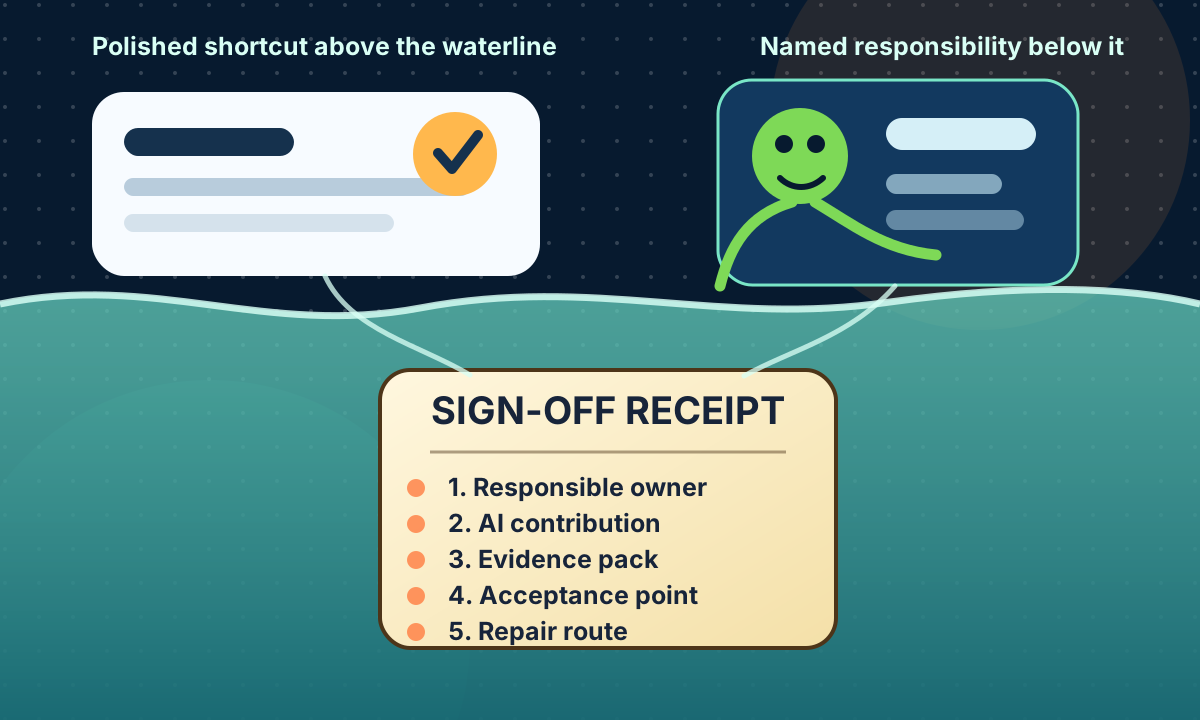
AI outputs become harder to govern when a summary, score, route, reply or recommendation moves forward without a named owner accepting responsibility for this use.
Before relying on an AI-shaped record, ask who signs it off, what the system contributed, what evidence was checked, where acceptance happens and who repairs mistakes.
AI often arrives with a useful promise: less waiting, less drafting, less sorting, less admin. The quiet question is who signs the result.
A summary can sound official. A score can look objective. A support reply can close a case. A model ranking can shape procurement. A classroom flag, hiring shortlist or public-service route can move a person into the next queue. But if nobody can say who accepted responsibility for the AI-shaped step, the shortcut has become a responsibility fog machine.
An AI sign-off receipt is the visible trail that says which person, team or office owns an AI-assisted output before it becomes a reply, record, recommendation, route, score or action. It does not mean every step must be slow or manual. It means the moment of trust has a name on it.
Why this matters now
AI use has moved from experiment to workplace habit. Stanford HAI reported that 78% of organisations used AI in 2024, up from 55% a year earlier. Anthropic’s Economic Index found AI appearing across task slices in many occupations, more often as augmentation than full automation. The practical implication is simple: more work will be partly machine-shaped and partly human-owned.
That split can be healthy. A person can use an AI draft, summary, search layer, benchmark or triage suggestion and still make a good decision. The risk comes when the machine-shaped part travels further than the human responsibility attached to it.
For ordinary readers, the sign-off question is not bureaucratic. It is the difference between “the system said so” and “this named owner checked, accepted and can repair this output.”
The building-inspector analogy
When a lift, boiler, fire alarm or public building is inspected, the certificate is not just decoration. It tells you who checked it, what was in scope, when it was checked, what limits remain and who to contact if something fails.
AI workflows need the same visible certificate. A polished answer or ranking is the shiny lift door. The sign-off receipt is the inspection sticker: not proof that nothing can go wrong, but proof that responsibility has not disappeared into the machinery.
Without that sticker, everyone can point elsewhere: the vendor blames the model, the model blames the data, the team blames the workflow, and the user is left arguing with a finished-looking record.
The five-line sign-off receipt
Use this receipt when an AI output can influence people, money, reputation, access, records or work routes:
- Responsible owner: which person, role, desk or organisation accepts the output as fit for this use?
- AI contribution: what exactly did the system draft, rank, summarise, search, flag, route, recommend or change?
- Evidence pack: what source material, model/tool label, date and policy window shaped the output?
- Acceptance point: where does a human explicitly approve, edit, reject, pause or escalate the AI-shaped step?
- Repair route: who corrects the record, tells affected people and updates the workflow when sign-off proves wrong?
Where to look first
The sign-off receipt matters most where AI output can harden into a record:
- Meetings: who owns the action list when an AI summary becomes the record everyone works from?
- Customer support: who signs a suggested reply before it closes a case or changes a customer’s options?
- Hiring and schools: who accepts responsibility for a flag, shortlist, feedback note or risk score?
- Search and research layers: who owns a source-backed answer when it is reused in a deck, policy note or purchasing decision?
- Model and procurement dashboards: who signs the recommendation when scores, costs, vendor wrappers and deployment context do not point in the same direction?
The practical habit is direct: when a tool says the AI step is ready, ask who is putting their name on it, what they saw, and how the record can be repaired.
Boiling Frogs lens: consequential AI needs a sign-off receipt: responsible owner, AI contribution, evidence pack, acceptance point and repair route.
Sources: Stanford HAI AI Index 2025, Anthropic Economic Index, NIST AI Risk Management Framework, OECD AI Principles.