
The AI safety label: tested upstream is not the same as safe everywhere
A plain-English briefing on frontier AI safety testing: why pre-release checks matter, what they do not prove, and how readers can translate a lab result into ordinary downstream questions.
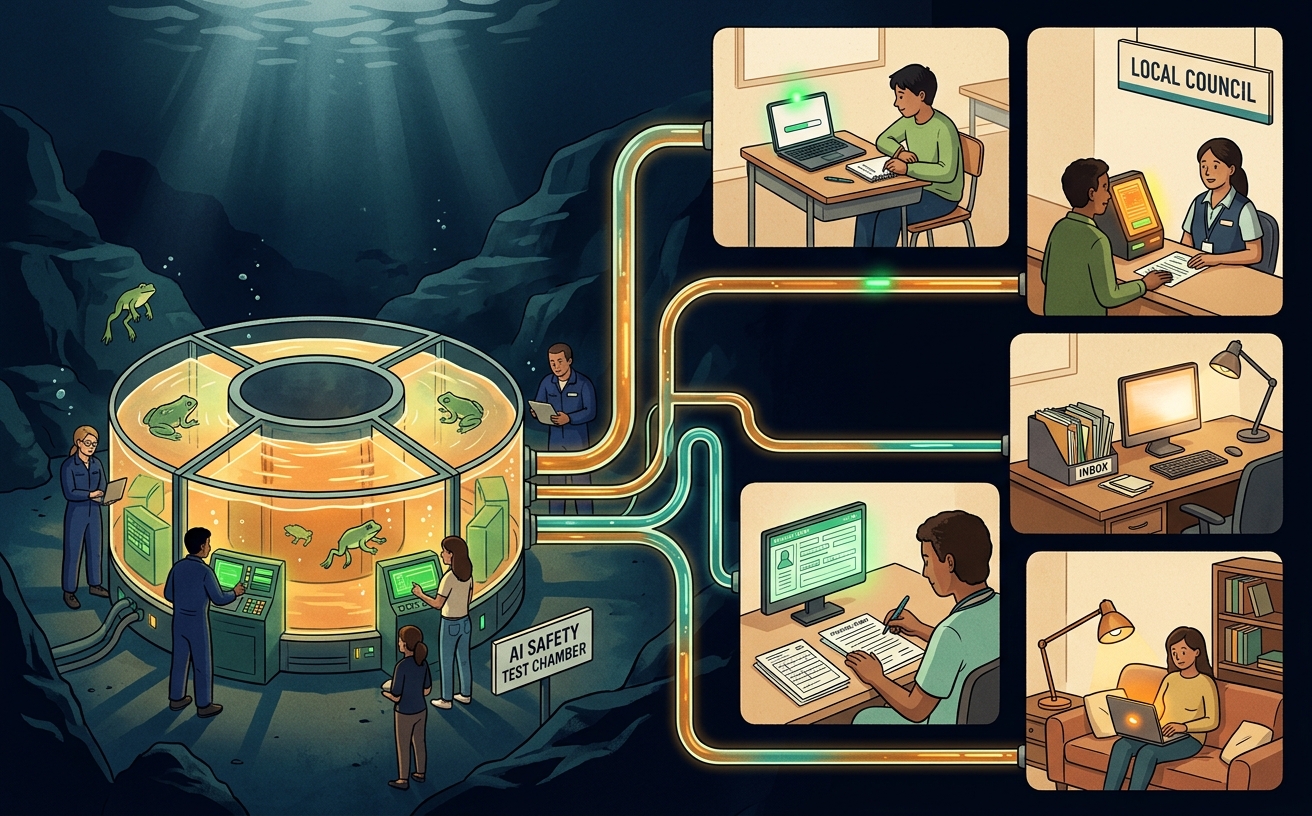
Frontier-model evaluations are becoming part of the AI supply chain, but a lab result is not the same as safe deployment everywhere.
When a product says tested, ask tested for what, by whom, in which product form, with which permissions and what changed after the test.
The latest AI safety story can sound reassuring: powerful systems are being tested before they reach the public.
That is good news. It is also not the end of the heat check.
A pre-release test is like inspecting the boiler at the factory. It can catch dangerous pressure, bad valves and weak parts. But the boiler still has to be installed in real buildings, connected to real pipes, used by real people, maintained by real organisations and switched on under real incentives.
The signal
In May 2026, the US National Institute of Standards and Technology announced that the Center for AI Standards and Innovation had signed agreements on frontier AI national-security testing. The important direction of travel is not only one agreement. It is the normalisation of testing powerful models before release as part of the AI supply chain.
The backdrop is already broad adoption. Stanford HAI’s 2025 AI Index reports that 78% of organisations used AI in 2024, up from 55% the year before. Anthropic’s Economic Index found AI use across roughly 36% of occupations in at least a quarter of their tasks.
The everyday translation: a model checked upstream may later sit inside office software, school platforms, search answers, customer-service tools, coding copilots, hiring filters or public-service forms. The test chamber matters because the downstream rooms are already filling with AI.
What a safety test can tell you
A serious pre-release evaluation can reveal whether a frontier model shows risky capabilities, follows dangerous instructions too easily, resists basic safeguards, or behaves unpredictably in controlled scenarios.
That is useful. It gives governments, labs and deployers a clearer thermometer than vibes.
But a lab test usually answers a narrower question than ordinary users need. It may say something about the model under particular prompts, access conditions, safeguards and evaluation tasks. It may not say enough about the product wrapper, the plug-ins, the data it can see, the workflow it is placed inside, the business target it optimises for, or the tired human who rubber-stamps its output at 5:45pm.
Where the water warms downstream
The school platform
A tested model can still create an untested habit. If pupils, parents and teachers start treating AI feedback as the first authority, the question becomes: can the student explain the work, and can a teacher see what evidence the system used?
The council or public-service form
An AI helper that summarises a case, routes a request or drafts a response may feel administrative. But small workflow choices can affect access to support. The heat check is: who can appeal the AI-framed version of the facts?
The office assistant
If a tested model sits inside email, meetings and documents, the risk is not only a dramatic failure. It is the quiet thinning of review. The heat check is: which AI outputs are people actually reading before sending?
The search answer
A safer model can still compress a messy topic into one confident answer. The heat check is: are sources visible, are omissions obvious, and can the reader find the original evidence?
Five questions to ask when you see “tested”
- Tested for what? Security, persuasion, misinformation, autonomy, bias, privacy, reliability, dangerous knowledge or something else?
- Tested by whom? The lab, a government body, a third party, customers, researchers or the public after launch?
- Tested in which form? The raw model, the product, the plug-in-enabled agent, the enterprise deployment or the public chatbot?
- Tested under which permissions? Read-only answer box, browser-using agent, file access, email access, payment access or record-changing access?
- What changes after testing? A delayed release, a fixed system card, a blocked capability, a monitoring plan, a warning label or no visible consequence?
The boiling-frog risk is not that safety testing is useless. It is the opposite: because testing sounds responsible, the phrase can become a blanket of reassurance.
A better reader habit is to treat “tested” as the start of the conversation. The lab tells us whether the boiler survived inspection. Boiling Frogs asks where it is being installed, who can read the pressure gauge, and who gets scalded if the water keeps warming quietly.