
The AI rollback receipt: can the shortcut be unwound?
A plain-English briefing for checking whether an AI-assisted decision, route, record or action can be reversed when the default path turns out to be wrong.
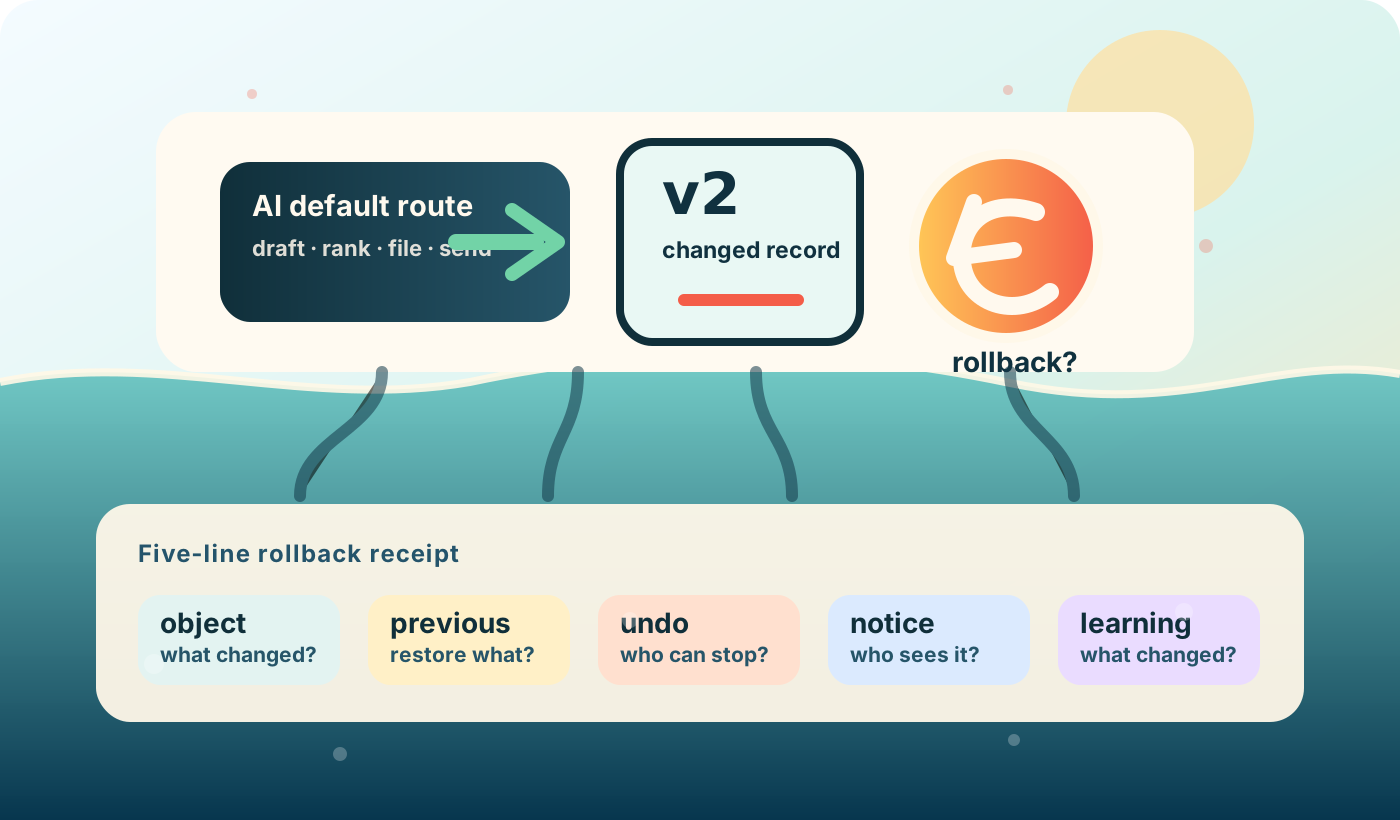
AI workflows become risky when a draft, score, route, record or action can move forward smoothly but cannot be restored, compared or challenged just as clearly.
Before accepting an AI shortcut as normal, ask what changed, what can be restored, who can undo it, who is told and what the system learns after rollback.
The most important AI question is not always whether a system can act. It is whether the action can be unwound.
Every week, more tools promise to draft, summarise, rank, route, recommend, file, approve, code or answer faster than a person could. That speed is useful. But when the shortcut becomes the default route, a second question should sit beside it: if the AI-shaped step is wrong, stale, biased, overconfident or simply unsuitable, can someone roll it back before the mistake hardens into a record?
An AI rollback receipt is the visible trail that says how an AI-assisted output or action can be reversed. It names the changed object, preserves the previous state, explains who can pause or undo the route, shows who is notified, and records what changed afterwards.
Why this matters now
AI is no longer a novelty layer on the side of work. Stanford HAI reported that 78% of organisations used AI in 2024, up from 55% the year before. Anthropic’s Economic Index shows AI use spreading through tasks across occupations, and the International Energy Agency’s 2025 report reminds us that the “weightless” answer box depends on a much larger physical build-out of data centres, chips, power and cooling.
For ordinary readers, that means rollback is not only a technical software feature. It is a public trust habit. A wrong support reply, automated meeting note, model ranking, school flag, hiring shortlist, procurement summary or council triage route can travel through other systems before anyone notices the first step was shaky.
The escalator analogy
An escalator is helpful because it moves people forward without effort. But the safety test is not only whether the steps move. It is whether there is a visible stop button, a clear handrail, space to step off, and someone responsible when the machine jolts.
AI defaults need the same design. If a tool can quietly move a case, generate a record, rank a person, send a reply or change the next screen, people need more than a promise that the model is good. They need a rollback receipt.
The danger is not just automation. The danger is one-way automation: a smooth route into the record, and a confusing complaint process out of it.
The five-line rollback receipt
Use this receipt before an AI-assisted workflow becomes normal:
- Changed object: what reply, score, summary, route, file, recommendation, code change or record did the AI alter?
- Previous state: what human-readable version, source bundle or decision path existed before the AI step?
- Undo control: who can pause, reverse, restore, compare or re-run the workflow without needing a specialist?
- Notice trail: who is told that the output was changed, challenged, reverted or replaced?
- Learning log: what rule, prompt, model, data source, permission or review threshold changed after rollback?
Where rollback should appear first
Start with places where AI outputs can become records or routes:
- Customer support: can a closed ticket be reopened with the original evidence and AI draft visible?
- Meetings: can an AI summary be corrected before it becomes the official action list?
- Hiring and education: can a score, flag or shortlist be challenged with the original material intact?
- Public services: can a triage route be paused before the person is sent down the wrong queue?
- Model and procurement dashboards: can a ranking or recommendation be replayed when benchmark data, costs or product wrappers change?
The practical habit is simple: before celebrating an AI shortcut, ask where the undo button lives, what it restores, and who sees the rollback.
Boiling Frogs lens: consequential AI needs a rollback receipt: changed object, previous state, undo control, notice trail and learning log.
Sources: Stanford HAI AI Index 2025, Anthropic Economic Index, IEA Energy and AI 2025, NIST AI Risk Management Framework.