
The AI provenance receipt: who touched the answer before you did?
A plain-English June briefing for checking AI answers, summaries and rankings before they harden into records: source, system, human, date and destination.
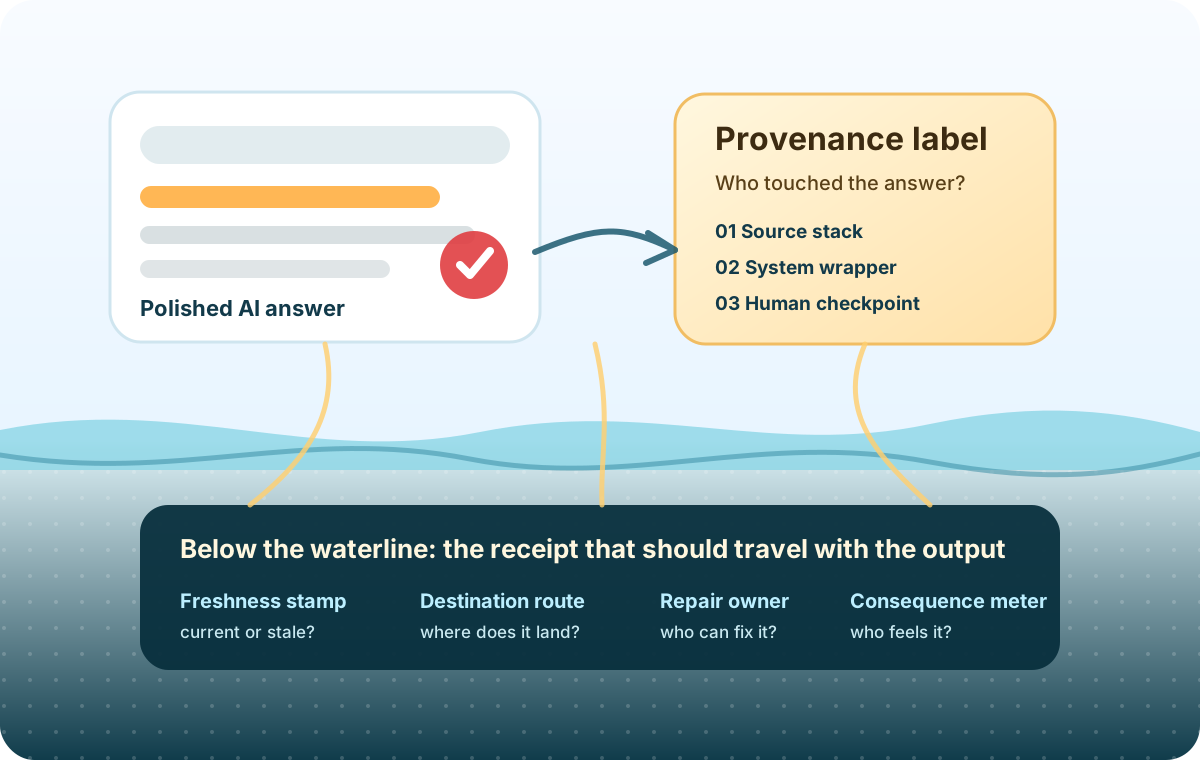
AI answers, summaries and rankings become harder to challenge when they travel like finished documents without showing source, system, date, human review and destination.
Before treating an AI output as evidence, ask what fed it, which product shaped it, who checked it, when it was updated and where it will land next.
The next AI habit to learn is not just asking, “is this answer right?” It is asking, who touched the answer before I did?
A search box gives one paragraph. A meeting tool writes the minutes. A workplace copilot turns scattered documents into a plan. A model leaderboard turns many tests into one rank. The output arrives polished, but the route behind it is often hidden: sources were selected, prompts were wrapped, safety filters were applied, product defaults were chosen, and sometimes a person approved the result after the fact.
That is the AI provenance receipt: a small label for the journey between raw evidence and the finished AI output.
Why this matters now
Four current signals make provenance less like paperwork and more like everyday literacy:
- AI is already inside normal organisations. Stanford HAI’s 2025 AI Index reports that 78% of organisations said they used AI in 2024, up from 55% the year before. Once AI is ordinary, the question shifts from “who is experimenting?” to “which outputs are becoming records?”
- The spread is happening task by task. Anthropic’s Economic Index says AI touches at least a quarter of tasks in more than a third of occupations. Provenance matters most at task boundaries: a summary becomes a file note, a ranking becomes a shortlist, a draft becomes a customer reply.
- Model testing is moving upstream. NIST’s CAISI announced May 2026 frontier-model testing agreements. Upstream tests help, but downstream readers still need to know which product wrapper, source set and human checkpoint shaped the answer they are using.
- The plumbing is getting heavier. The IEA projects data-centre electricity demand rising from roughly 460 TWh in 2022 to 945 TWh by 2030. AI can feel weightless at the screen while the real-world stack behind it gets larger, costlier and more concentrated.
The now-story is not only that AI produces more answers. It is that AI answers are starting to travel like official documents without always carrying their paperwork.
The everyday analogy
Think of a parcel label.
You do not need to inspect the whole warehouse to accept a delivery, but you do want the basic label: sender, route, date, handler, destination and whether the parcel was opened or repacked. Without that label, a neat box on the doorstep is still a mystery.
AI outputs need the same label. The answer is the parcel. The provenance receipt tells you what evidence was packed inside, which system handled it, whether a person checked it, when it was made and where it is going next.
The five-line provenance receipt
Before treating an AI answer, summary, ranking or recommendation as usable evidence, ask for this receipt:
| Receipt line | Plain-English test | Reader question |
|---|---|---|
| Source stack | What documents, links, transcripts, tests or data fed the output? | Can I inspect the original material or only the polished answer? |
| System wrapper | Which product, model, prompt template or retrieval layer shaped it? | Did the tool merely summarise, or did it select, rank, rewrite or omit? |
| Human checkpoint | Who reviewed the output before it moved on? | Was there a real sign-off, a quick glance or no human stop at all? |
| Freshness stamp | When were the sources and model result last updated? | Is this a current reading, a stale snapshot or a timeless explainer? |
| Destination route | Where will the output land next? | Is it just advice, or will it affect records, grades, jobs, benefits, money or reputation? |
This is not a demand that every casual AI answer comes with a legal dossier. It is a habit for spotting when a smooth answer is about to become evidence.
Where to use it tomorrow
- In meetings: ask whether the AI minutes link back to the recording, transcript and disputed points before becoming the official record.
- In search: ask whether the answer layer shows sources, omissions and date stamps before replacing source choice.
- In schools: ask whether AI feedback names the student work it read and the teacher checkpoint before it becomes a grade conversation.
- In hiring: ask whether a shortlist can show criteria, excluded evidence and human review before it shapes interviews.
- In customer support: ask whether a generated reply carries the policy source and escalation route before it reaches a customer.
- In model rankings: ask whether “best” means best for this benchmark, this task, this cost, this openness requirement and this downstream setting.
The boiling-frog risk is that provenance disappears because the answer looks finished. The reader’s move is simple: when an AI output starts to act like a document, ask for the label.
Boiling Frogs lens: judge AI outputs by their provenance receipts: source stack, system wrapper, human checkpoint, freshness stamp and destination route.
Sources: Stanford HAI 2025 AI Index, Anthropic Economic Index, NIST / CAISI frontier-model testing agreements, IEA Energy and AI.