
The AI pilot-light receipt: when experiments become default work
A plain-English June briefing on the quiet shift from AI pilots to everyday defaults, with a receipt for spotting when a small test has become the route everyone now uses.
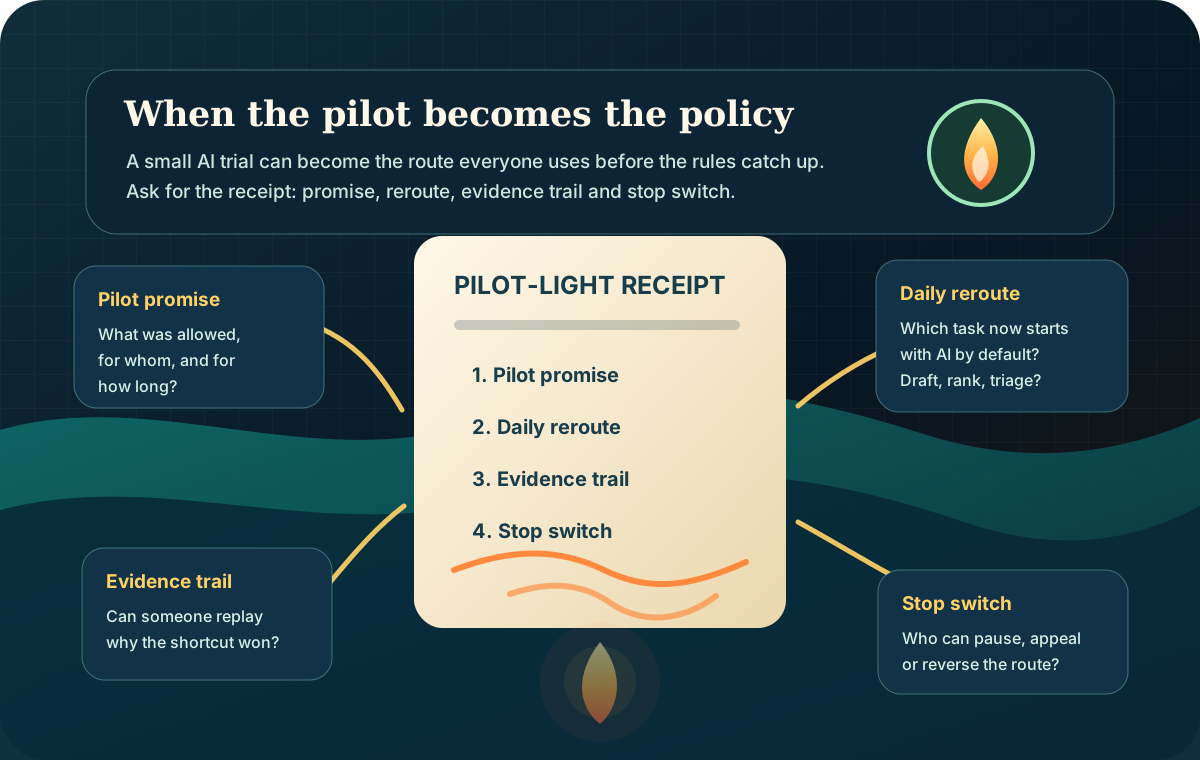
AI pilots become harder to govern when the temporary trial quietly turns into the route people are expected to use.
When someone says an AI workflow is only a pilot, ask what was promised, which daily task has been rerouted, what evidence travels and where the stop switch sits.
The easiest AI change to miss is the one that still calls itself a pilot.
A team tests meeting summaries. A school tries AI feedback. A support desk adds an answer assistant. A council experiments with triage. A workplace suite quietly suggests first drafts. At first it is framed as optional, temporary and low-risk. Then the button stays. The old route becomes slower. The AI route becomes the normal route.
That is the AI pilot-light receipt: a quick way to ask when an experiment has stopped being a test and started warming the whole room.
Why this matters now
Four current signals make the pilot-light question sharper:
- AI use has moved beyond the lab. Stanford HAI’s 2025 AI Index reports that 78% of organisations said they used AI in 2024, up from 55% the year before. A pilot no longer sits at the edge of the building; it often sits inside tools people already open every morning.
- The change arrives task by task. Anthropic’s Economic Index says AI touches at least a quarter of tasks in more than a third of occupations. That is how pilots become defaults: not by replacing a job title overnight, but by rerouting drafts, summaries, comparisons, rankings and escalations.
- Upstream safety checks are becoming formal. NIST’s CAISI announced May 2026 agreements for frontier-model testing. That is important, but readers still need the downstream question: did the tested model become a product default in a school, support queue, inbox or public-service workflow?
- The small button has a large meter behind it. The IEA projects data-centre electricity demand rising from roughly 460 TWh in 2022 to 945 TWh by 2030. A “try AI” pilot feels local; scaled defaults become infrastructure.
The now-story is not simply “more AI pilots.” It is: which pilots quietly became policy, who noticed the switch, and what evidence proves the old route is still available.
The everyday analogy
Think of the pilot light on a boiler.
It is tiny, almost invisible, and easy to ignore. But if it stays on long enough, it changes the temperature of the house. Nobody has to announce that winter policy changed; people just start behaving as if the room is meant to be warmer.
AI pilots work the same way. The trial button may look modest. The meeting summary saves ten minutes. The ranking saves one queue. The draft saves one manager an hour. Then the organisation quietly designs work around the shortcut. The real governance question is not whether the pilot was useful on day one. It is whether the pilot changed the room before anyone wrote down the new rules.
The four-line pilot-light receipt
Before treating an AI pilot as harmless background heat, ask for this receipt:
| Receipt line | Plain-English test | Reader question |
|---|---|---|
| Pilot promise | What was the experiment originally allowed to do, and for how long? | Was it a test with an end date, or a default waiting to happen? |
| Daily reroute | Which ordinary task now starts with AI: draft, summary, triage, ranking, feedback or search? | What is slower, harder or culturally awkward if a person chooses the old route? |
| Evidence trail | What logs, sources, evaluations and corrections travel with the AI output? | Could someone reconstruct why the shortcut was accepted? |
| Stop switch | Who can pause, reverse, narrow or appeal the AI-assisted workflow? | Is there a real off-ramp, or only a settings label? |
This is not an argument against experimentation. Pilots are how organisations learn. The danger is pilot without receipt: a small flame that becomes the heating system while everyone still talks as if it is only a trial.
Where to use it tomorrow
- In meetings: ask whether AI minutes are optional notes or the record people now quote.
- In customer support: ask whether a triage assistant is suggesting responses or shaping which complaints reach a human.
- In schools: ask whether AI feedback is a learning aid or the first layer of assessment memory.
- In hiring: ask whether ranking tools are a pilot, a filter, or the default shortlist path.
- In public services: ask whether a trial classifier can be challenged with the evidence visible.
- In workplace suites: ask whether the AI-first draft has become the expected starting point for work quality and speed.
The boiling-frog risk is that AI policy does not always arrive as a policy. Sometimes it arrives as a pilot, a button, a convenience and then a habit.
Boiling Frogs lens: when someone says “it is only an experiment,” ask for the pilot-light receipt: the promise, the reroute, the evidence trail and the stop switch.
Sources: Stanford HAI 2025 AI Index, Anthropic Economic Index, NIST / CAISI frontier-model testing agreements, IEA Energy and AI.