
The AI override receipt: who can take the wheel back?
A plain-English briefing for spotting whether an AI workflow still gives people a real override when automation becomes the default route.
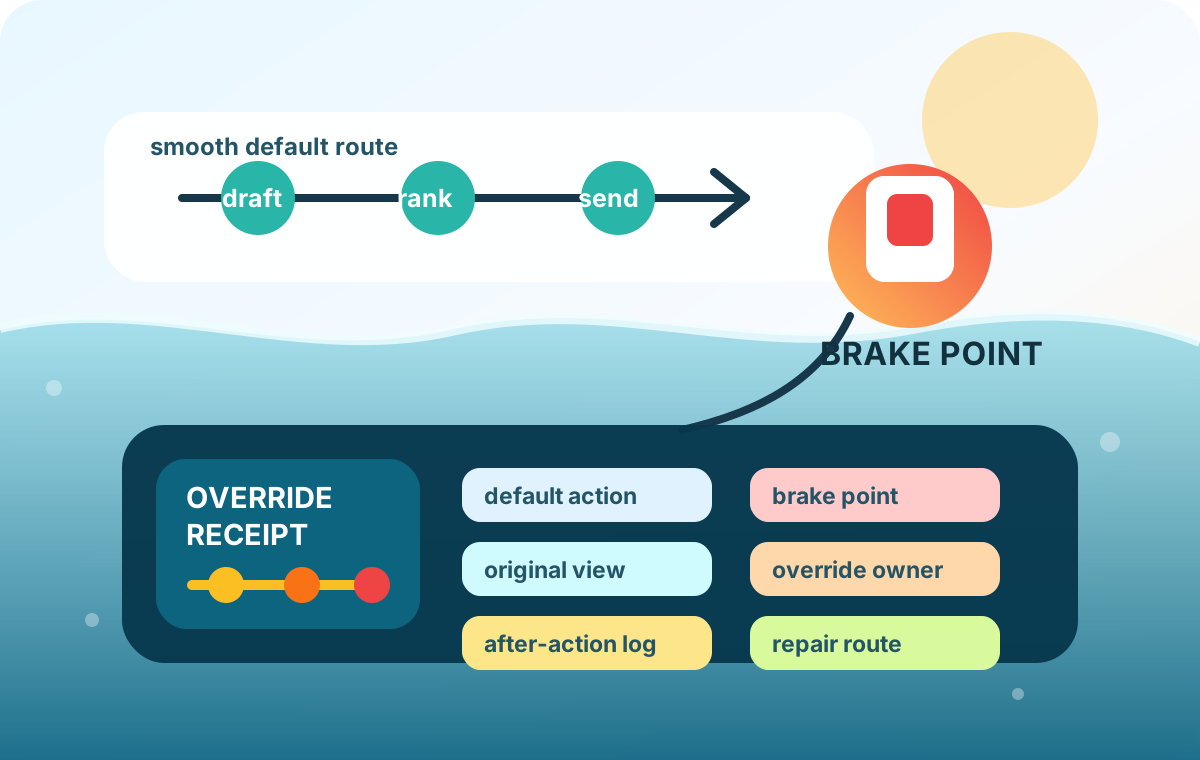
AI workflows become harder to govern when the default path can draft, rank, send or file before people can see where the brake point sits.
When AI becomes the easy route, ask what happens by default, where a person can stop it, what original evidence remains visible, who can reverse it and what log survives.
The next quiet AI risk is not a robot refusing orders. It is a workflow that politely stops offering a meaningful override.
An AI meeting note becomes the record. A support copilot drafts the reply. A search answer becomes the first source. A model leaderboard becomes the shortlist. A school tool suggests feedback. A procurement dashboard marks a vendor as safe. Each step may look helpful on its own. Together, they can turn a human choice into a small button, hidden setting or after-the-fact complaint form.
That is why ordinary AI literacy now needs an AI override receipt: a visible way to ask whether people can still take the wheel back before an AI-shaped output becomes a reply, record, route, score, purchase or decision.
Why this matters now
Three current signals make override a practical issue, not a science-fiction one:
- AI is being absorbed into ordinary task flows. Anthropic’s Economic Index found AI use touching at least a quarter of tasks in 36% of occupations. The everyday translation: the first override problem may appear inside a normal draft, summary, queue or ranking, not inside a dramatic autonomous system.
- Risk guidance keeps pointing to control, monitoring and accountability. The NIST AI Risk Management Framework asks organisations to govern, map, measure and manage AI risks. For a reader, that becomes one concrete question: if the tool is wrong, who can stop it before it travels further?
- Regulators are moving from principles to obligations. The EU AI Act phases in duties around transparency, risk management and human oversight for higher-risk AI uses. The plain-English lesson is simple: as AI becomes infrastructure, the override can no longer be a vague promise.
The boiling-frog danger is not that every AI output is wrong. It is that the default path becomes so convenient that the override quietly moves out of reach.
The everyday analogy
Think of cruise control in a car.
Cruise control is useful because the driver can tap the brake, steer, change lane, slow down for rain, respond to a cyclist or turn it off entirely. If the car kept speed while hiding the brake pedal under the dashboard, nobody would call that convenience.
AI workflows need the same visible brake. Not a panic button for every sentence. A real override at the point where automation starts shaping someone else’s record, route or options.
The five-line override receipt
Use this receipt whenever an AI system drafts, summarises, ranks, routes, scores, buys, books, files or recommends something that people may later treat as settled:
| Receipt line | Plain-English test | Reader question |
|---|---|---|
| Default action | What does the AI do if nobody intervenes? | Draft only, send, rank, hide, file, escalate, buy, notify, score or decide? |
| Brake point | Where can a person stop it? | Before publication, before the record changes, before the customer sees it, before a shortlist closes? |
| Original view | Can people see what the AI changed? | Source text, old ranking, raw evidence, previous policy, human note or uncompressed transcript? |
| Override owner | Who has authority to reverse it? | User, worker, manager, teacher, clinician, support lead, procurement owner or public-service caseworker? |
| After-action log | What remains after override? | Change reason, timestamp, affected users, downstream records, repair notice and model/tool version? |
The test is not whether automation exists. The test is whether automation remains interruptible at the moment it starts to matter.
Where it lands tomorrow
- In workplace copilots: an employee should know whether an AI draft is only a suggestion or the version colleagues will treat as the source of truth.
- In support desks: a customer dispute should expose the original evidence and let a human repair the answer before the bad record spreads.
- In schools: AI feedback should have a teacher-owned brake before a suggestion becomes a grade, intervention note or family message.
- In public services: a case summary should be reversible before it affects eligibility, priority, enforcement or appeal rights.
- In model and vendor dashboards: a ranking should be overrideable when the task, cost, openness, evidence window or local risk does not match the buyer’s need.
The useful habit is blunt: whenever AI becomes the default route, ask where the brake point is.
Boiling Frogs lens: every AI workflow that can move work forward needs an override receipt: default action, brake point, original view, override owner and after-action log.
Sources: Anthropic Economic Index, NIST AI Risk Management Framework, EU AI Act overview.