
The AI memory receipt: when the summary becomes the record
A plain-English June briefing on the quiet shift from AI as a note-taker to AI as the memory layer for meetings, services, classrooms and decisions.
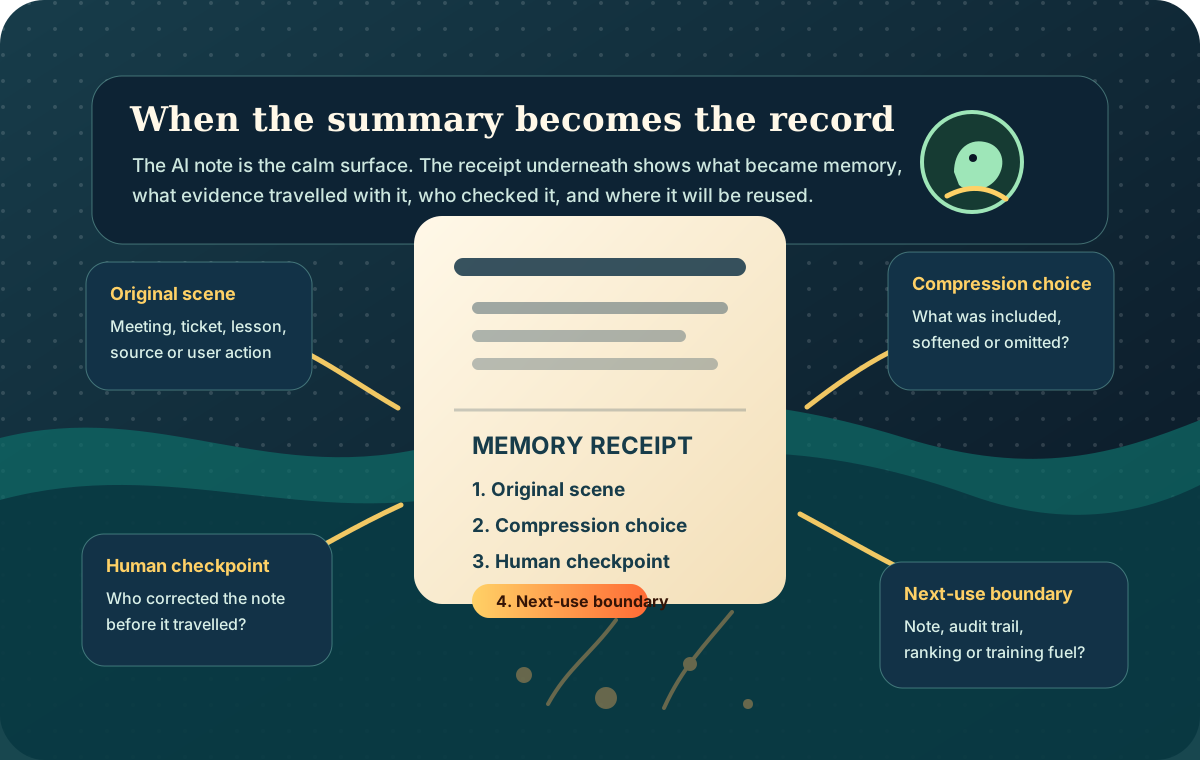
AI summaries become more consequential when they stop being helpful notes and start acting as the record future people and systems rely on.
Before accepting an AI summary as official memory, ask what original scene it compressed, what evidence travelled, who checked it and where the note will be reused next.
The quietest AI handoff is not the reply. It is the memory.
A meeting summary becomes the official account. A support chatbot decides what context the next agent sees. A school platform turns a lesson into feedback. A search assistant compresses the web into a few lines. A workplace tool remembers the task trail for everyone else.
That is the AI memory receipt: a quick way to ask whether a polished summary is a helpful note, or whether it has quietly become the record that future people and systems will act on.
Why this matters now
Four current signals make the memory question sharper:
- AI is already moving through ordinary work tasks. Anthropic’s Economic Index says AI touches at least a quarter of tasks in more than a third of occupations. Many of those tasks are memory-shaped: summarising, comparing, drafting, classifying and retrieving.
- Organisations have moved from pilots to defaults. Stanford HAI’s 2025 AI Index reports that 78% of organisations said they used AI in 2024, up from 55% the year before. Once AI is inside the workplace suite, the summary often arrives before the debate about whether it should count as the record.
- Pre-release model testing is moving upstream. NIST’s CAISI announced May 2026 frontier-model testing agreements. That is useful, but the downstream question remains: did anyone test how the model behaves when its summary becomes a file note, ticket history, learning record or audit trail?
- The memory layer has a physical bill. The IEA projects data-centre electricity demand rising from roughly 460 TWh in 2022 to 945 TWh by 2030. The saved note feels weightless; the infrastructure that stores, retrieves and reuses it does not.
The now-story is not just “AI writes notes.” It is: who gets to write the institutional memory, what evidence stays attached, and how easily a person can correct it later.
The everyday analogy
Think of a relay race with a baton.
If the baton is clean, labelled and handed over in sight, the next runner knows what they are carrying. If the baton is smudged or swapped behind a curtain, the race may still look smooth — until somebody asks why the wrong runner is now sprinting with the wrong instruction.
AI summaries are batons. They carry context from one person to the next: from meeting to manager, customer to agent, pupil to teacher, patient to clinician, applicant to recruiter. A fluent summary can make the handoff faster. It can also erase the hesitation, missing evidence, dissenting voice or source caveat that made the original situation human.
The four-line memory receipt
Before treating an AI-generated memory as official, ask for this receipt:
| Receipt line | Plain-English test | Reader question |
|---|---|---|
| Original scene | What conversation, document, source or user action did the system compress? | Could someone return to the original without special access? |
| Compression choice | What did the AI include, omit, rename, soften or overstate? | Which detail would change the decision if it were missing? |
| Human checkpoint | Who saw the summary before it became the record? | Was correction easy, or did the polished version travel too fast? |
| Next-use boundary | Where will this memory be reused: training, ranking, triage, audit, search, personalisation or management? | Is the note only a note, or fuel for the next decision? |
This is not an argument against summaries. Good summaries save time. The danger is summary without receipt: a clean paragraph that looks like memory, but hides the trail that would let a person inspect, challenge or repair it.
Where to use it tomorrow
- In meetings: ask whether the AI minutes became the official memory, and whether disagreement or uncertainty survived the edit.
- In customer support: ask whether the next agent sees the real complaint or only a softened model recap.
- In schools: ask whether AI feedback records what a learner understood, or just what the system inferred from a submitted answer.
- In hiring: ask whether a candidate’s record includes the original evidence, not only a ranked summary.
- In public services: ask whether a case note can be appealed with the underlying source visible.
- In search and research: ask whether the answer layer preserves enough citations for a reader to reconstruct the path.
The boiling-frog risk is that AI memory becomes normal because each summary feels useful. By the time the organisation notices the record has changed, the record may already be deciding what happens next.
Boiling Frogs lens: do not just ask whether AI summarised accurately. Ask what became memory, what evidence travelled with it, who checked it, and where that memory will be reused.
Sources: Anthropic Economic Index, Stanford HAI 2025 AI Index, NIST / CAISI frontier-model testing agreements, IEA Energy and AI.