
The AI maintenance receipt: who keeps the system safe after launch?
A plain-English briefing for checking whether an AI workflow has an owner, inspection rhythm and repair route after the shiny pilot becomes everyday infrastructure.
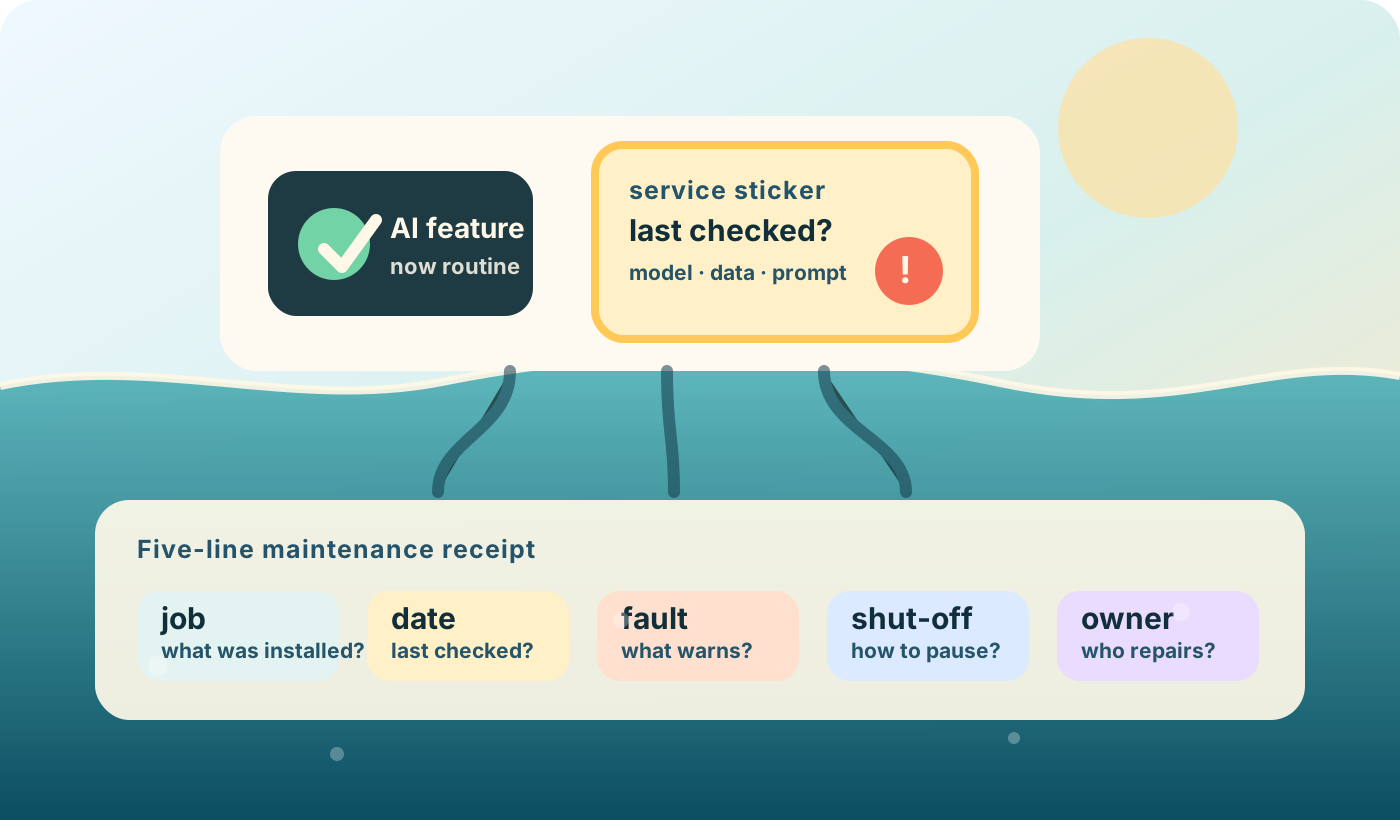
AI workflows become risky when the launch story ends but nobody owns inspection, stale evidence, drift, shutdown or repair after the tool becomes routine.
When AI becomes part of the building, ask what job was installed, when it was checked, what warns users, how to pause it and who fixes harm.
AI usually arrives as a launch story: a demo, a pilot, a new assistant in the menu, a leaderboard row, a support copilot, a meeting summary button. The harder question comes later, when the tool is no longer news. Who checks whether it still works, whether the evidence is stale, whether the cost has moved, whether people can still challenge it, and whether the workflow should be rolled back?
That is the point of an AI maintenance receipt. It treats an AI system less like a magic feature and more like a boiler, lift, bridge or office fire alarm: useful infrastructure that needs named inspection, visible faults, service dates and a repair owner after installation.
Why this matters now
AI adoption is spreading faster than many organisations can build governance muscle. Stanford HAI reported that 78% of organisations used AI in 2024, up from 55% a year earlier. Anthropic’s Economic Index frames the change at task level: roughly 36% of occupations already show AI use in at least a quarter of tasks. The International Energy Agency adds the physical layer: data-centre electricity demand could rise from about 460 TWh in 2022 to 945 TWh by 2030.
For everyday readers, those numbers mean AI is becoming less like a one-off app and more like building services: hidden until it fails, expensive when it scales, and difficult to inspect if nobody kept the maintenance log.
The boiler-room analogy
A boiler is not safe because the brochure says it is efficient. It is safer because somebody can point to the service date, inspection certificate, fault light, shut-off valve and person responsible for fixing it.
AI workflows need the same plain-English habit. A hiring screen, support reply, school feedback tool, meeting memory layer or model-selection dashboard should not only say what it can do. It should show how it will be looked after once it becomes ordinary.
The quiet danger is not just a bad first output. It is a good-looking workflow that keeps running after the model changes, the policy changes, the source data expires, the cost rises, or the human review step quietly thins out.
The five-line maintenance receipt
Use this receipt when an AI system has moved from experiment into routine work:
- Installed job: what task did AI take over, speed up or quietly frame?
- Service date: when was the model, prompt, data source, policy wrapper or benchmark last checked?
- Fault signal: what visible warning tells a user, teacher, manager or customer that the output may be wrong, stale or incomplete?
- Shut-off route: how can the workflow be paused, downgraded or returned to a human path before more records harden?
- Repair owner: which named team or role fixes the tool, tells affected people and records what changed?
Where to look first
Start with AI that is already boring enough to be dangerous:
- Meeting summaries: the note becomes institutional memory, but the original context and correction lane may vanish.
- Support copilots: a reply can sound solved while policy, evidence and escalation thresholds drift behind it.
- School and HR tools: feedback, flags and rankings can keep travelling after the evidence window changes.
- Procurement dashboards: a “best model” row may become a buying shortcut even when cost, wrapper and task fit have moved.
- Public-service triage: a case route can feel official before the affected person sees the maintenance record behind it.
The practical habit is simple: when an AI feature becomes part of the building, ask for the service sticker.
Boiling Frogs lens: AI infrastructure needs a maintenance receipt: installed job, service date, fault signal, shut-off route and repair owner.
Sources: Stanford HAI AI Index 2025, Anthropic Economic Index, IEA Energy and AI 2025, NIST AI Risk Management Framework.