
The AI incident receipt: what happens when the shortcut breaks?
A plain-English briefing for checking whether an AI workflow has a visible incident trail when a summary, score, route, reply or agent action goes wrong.
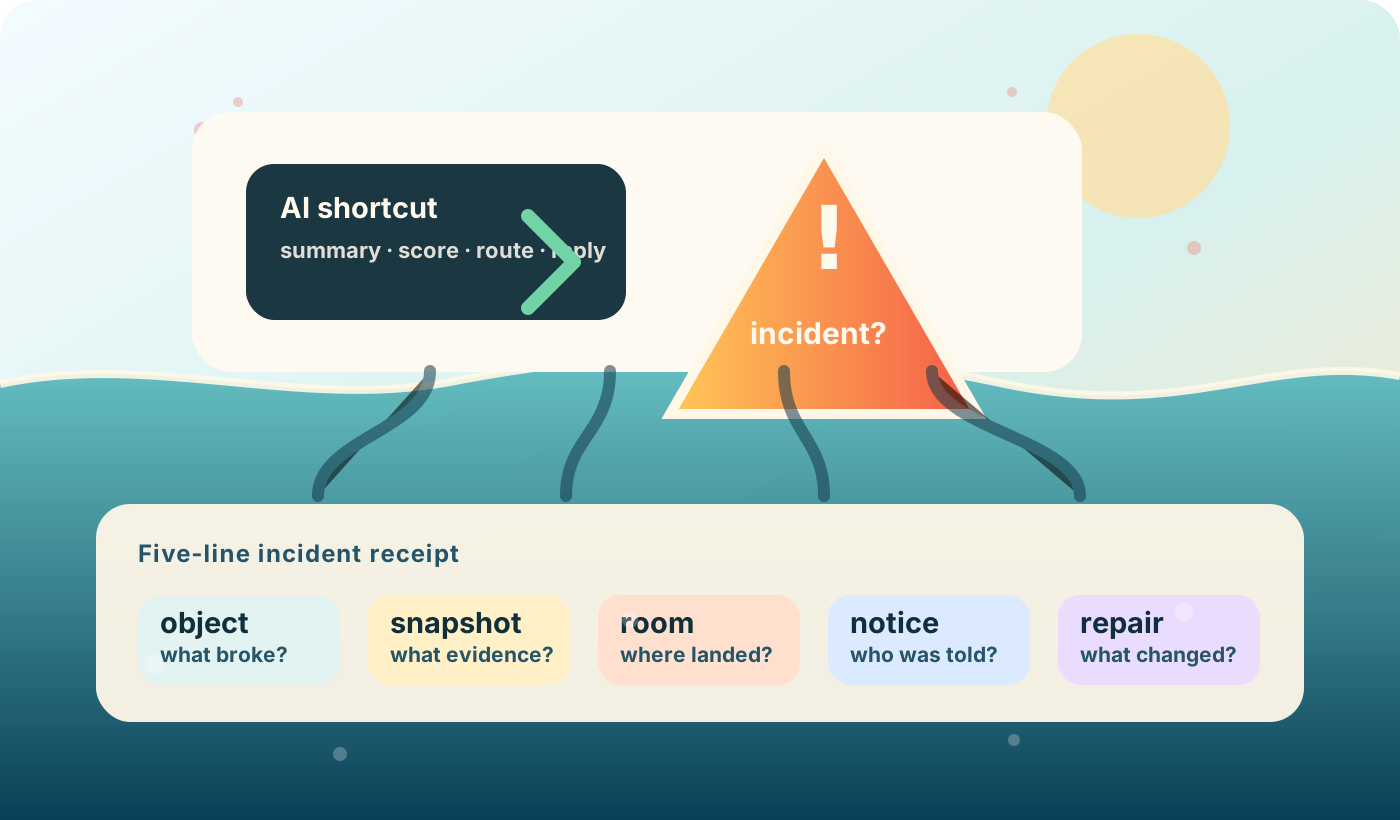
AI workflows become risky when a bad summary, score, route, reply or agent action enters the record without an alarm, pause point or repair owner.
When an AI shortcut breaks, ask what went wrong, what evidence shaped it, where it landed, who was told and what changed before it runs again.
AI safety often sounds like a pre-launch question: was the model tested, red-teamed, benchmarked and approved before people used it? That matters. But the everyday governance test usually arrives later, after an AI shortcut is already sitting inside support queues, classrooms, meeting notes, hiring screens, procurement dashboards, search answers or public-service triage.
The question then becomes simpler and sharper: when the AI-shaped route breaks, can anyone see the incident receipt?
An AI incident receipt is the plain-English trail that should appear after a consequential AI output misfires. It says what happened, who was affected, what evidence was used, how the workflow was paused or corrected, who owns the repair, and what changed so the same failure is less likely next time.
Why this matters now
AI adoption is no longer a niche experiment. Stanford HAI reported that 78% of organisations used AI in 2024, up from 55% the year before. Anthropic’s Economic Index shows AI use already appearing across a wide spread of work tasks, with roughly 36% of occupations showing AI use in at least a quarter of tasks. The International Energy Agency’s 2025 AI and energy report adds a physical reminder: data-centre electricity demand could roughly double by 2030.
For ordinary readers, those numbers mean AI errors will not only be chatbot bloopers. They will show up as wrong summaries, stale evidence, misrouted cases, overconfident support replies, skewed shortlists, hidden costs and automated records that other people later treat as fact.
The fire-drill analogy
A building does not prove it is safe by saying the alarm was installed. It proves more when people can see the fire-drill route: who heard the alarm, which door opened, who checked the room, where the incident was logged, and what was fixed afterwards.
AI workflows need the same habit. A smooth assistant can make a bad route feel official because the output arrives neatly formatted, confidently worded and already placed in the next system. The incident receipt is the drill map for the moment the neat output turns out to be wrong.
The quiet danger is not that AI makes a mistake. The quiet danger is that the mistake enters the record with no alarm bell, no pause point, no affected-person notice and no repair owner.
The five-line incident receipt
Use this receipt when an AI output, route or action may have caused harm, confusion or a bad record:
- Incident object: what summary, score, reply, route, shortlist, file, recommendation or action went wrong?
- Evidence snapshot: what sources, model version, prompt, policy wrapper, data window or user inputs shaped it at the time?
- Affected room: where did the output land — customer inbox, classroom, HR file, support queue, dashboard, public answer or procurement note?
- Pause and notice: how was the workflow stopped, marked, corrected or explained to the people affected?
- Repair loop: who owns the fix, what changed, and where is the lesson logged for the next deployment?
Where to look first
Start with AI shortcuts that are already close to records or decisions:
- Support replies: a confident answer can close a ticket before policy, evidence or escalation has been checked.
- Meeting summaries: a compressed note can become institutional memory while objections and uncertainty disappear.
- School or HR tools: feedback, flags and shortlists can travel farther than the original evidence.
- Search and research answers: a polished synthesis can hide a stale or incomplete source trail.
- Public-service triage: a routed case can feel official before the affected person knows how to challenge it.
The practical habit is simple: do not only ask whether the AI system was tested before launch. Ask where the incident receipt will appear after something goes wrong.
Boiling Frogs lens: consequential AI needs an incident receipt: incident object, evidence snapshot, affected room, pause and notice, and repair loop.
Sources: Stanford HAI AI Index 2025, Anthropic Economic Index, IEA Energy and AI 2025, NIST AI Risk Management Framework.