
The AI handoff gap: when a polished answer outruns responsibility
A plain-English June briefing on the gap between AI capability and human accountability: where a tool drafts, ranks or routes faster than anyone can inspect the handoff.
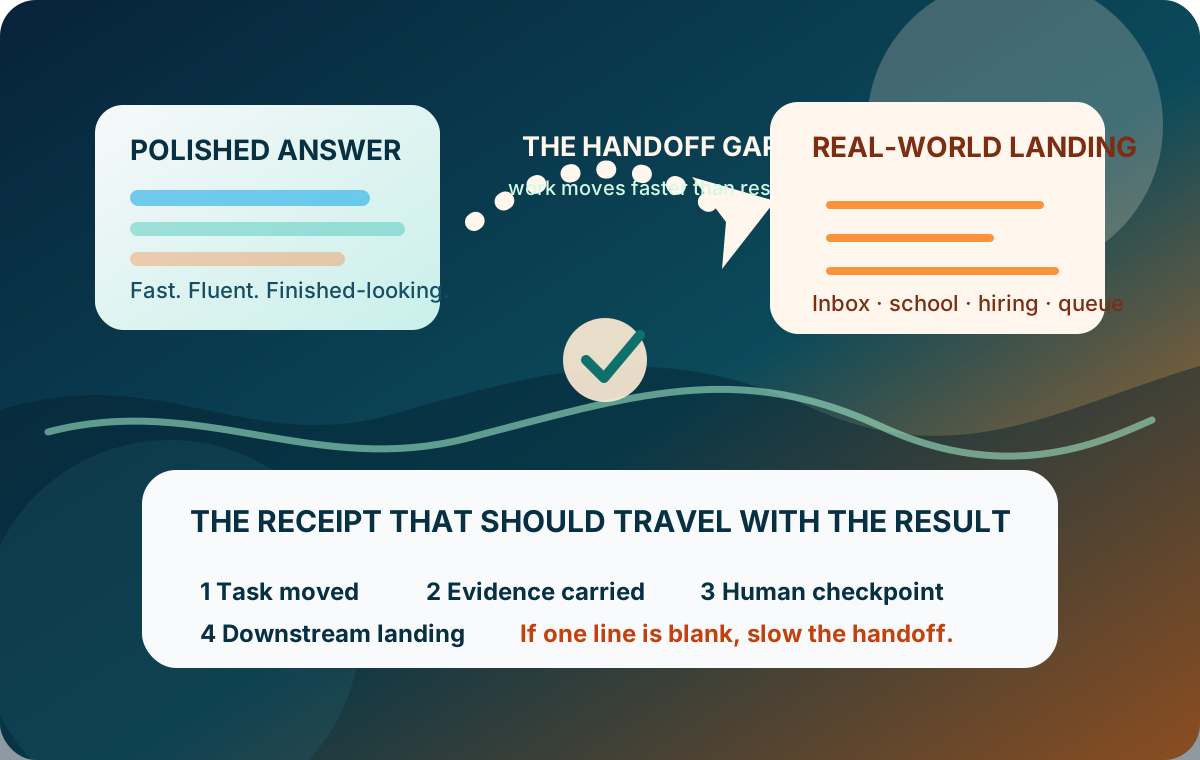
AI can move work forward faster than responsibility moves with it, especially when summaries, rankings, drafts and agent actions look finished before they are inspected.
Before treating an AI result as done, ask what task moved, what evidence travelled, where the human checkpoint sits and who carries the downstream consequence.
The dangerous moment is not always when AI gets something wrong.
It is when the answer looks finished enough that nobody notices the handoff gap: the small space between what the system did and who is now responsible for living with it.
A handoff gap appears whenever AI moves a task forward before the human check catches up. It can be a draft email, a ranked shortlist, a support escalation, a classroom summary, a code change, a search answer, or a model leaderboard. The output arrives polished. The accountability arrives late.
Why this matters now
Three current signals make the gap worth watching:
- AI is spreading through tasks, not just job titles. Anthropic’s Economic Index says AI touches at least a quarter of tasks in more than a third of occupations. That means the normal unit of change is the handoff: who drafts, who reviews, who decides, who signs.
- Evaluation is moving closer to release. NIST’s CAISI signed pre-release frontier-model testing agreements in May 2026. That is a useful step, but it still leaves the product question: what happens when the tested model is wrapped in a workplace tool, school product, search box or agent workflow?
- The hidden bill is physical. The IEA projects data-centre electricity demand rising from about 460 TWh in 2022 to about 945 TWh by 2030. The polished answer is the tap; the cloud contract, chips, cooling and grid load are the plumbing.
Put those together and the story is not “AI is clever.” The story is: AI moves work across a boundary, and the receipt for that move is often missing.
The everyday analogy
Think of a parcel delivery left outside a flat.
The tracking page says “delivered.” The driver has moved on. The sender thinks the job is done. But the person who needed the parcel still has the real question: where exactly is it, who signed, what proof exists, and what happens if it is gone?
AI handoffs work the same way. A summary can be “delivered” into a meeting. A ranking can be “delivered” into a hiring desk. A support answer can be “delivered” to a customer. But if nobody can see the source, assumption, reviewer or appeal route, the work has moved without a proper proof-of-delivery slip.
The four-part handoff receipt
Before treating an AI result as finished, ask for the receipt:
| Receipt line | Plain-English test | Reader question |
|---|---|---|
| Task moved | What exact job did the system advance: draft, rank, route, summarise, compare, approve or act? | Did AI merely help, or did it change the decision frame? |
| Evidence carried | What sources, logs, constraints or missing context travelled with the output? | Could a reviewer reconstruct the path later? |
| Human checkpoint | Where did a person meaningfully inspect, edit, approve, appeal or reject it? | Is the human a real decision-maker or a decorative rubber stamp? |
| Downstream landing | Where does the result affect a person, budget, classroom, queue, codebase or public record? | Who lives with the consequence if the answer is wrong? |
This is not bureaucracy for its own sake. It is how ordinary readers keep agency when software becomes smoother than the accountability around it.
Where to use it tomorrow
- In meetings: ask whether the AI summary included dissent, uncertainty and omitted documents, or only the tidiest narrative.
- In hiring: ask whether a ranking changed who got seen first, and whether candidates can challenge the evidence.
- In schools: ask whether the student can explain the work after the tool helped produce it.
- In customer support: ask whether the human agent sees the bot’s assumptions before replying.
- In procurement: ask whether the tested model is the same product, setting, permissions and workflow you are buying.
- In AI rankings: ask whether the “best” model is best for your task, your budget, your data and your tolerance for opacity.
The boiling-frog risk is that each handoff feels efficient in isolation. A cleaner draft here, a faster ranking there, a helpful summary everywhere. Then one day the organisation discovers that responsibility has been moved around the room without anyone naming where it landed.
Boiling Frogs lens: do not just ask what the AI produced. Ask what it moved, what proof travelled with it, where the human checkpoint sits, and who carries the consequence.
Sources: Anthropic Economic Index, NIST / CAISI frontier-model testing agreements, IEA Energy and AI.