
The AI exception receipt: when the shortcut needs a stop lane
A plain-English June briefing on the next AI habit to inspect: not whether the default works on average, but what happens when it is wrong, contested or too consequential to automate.
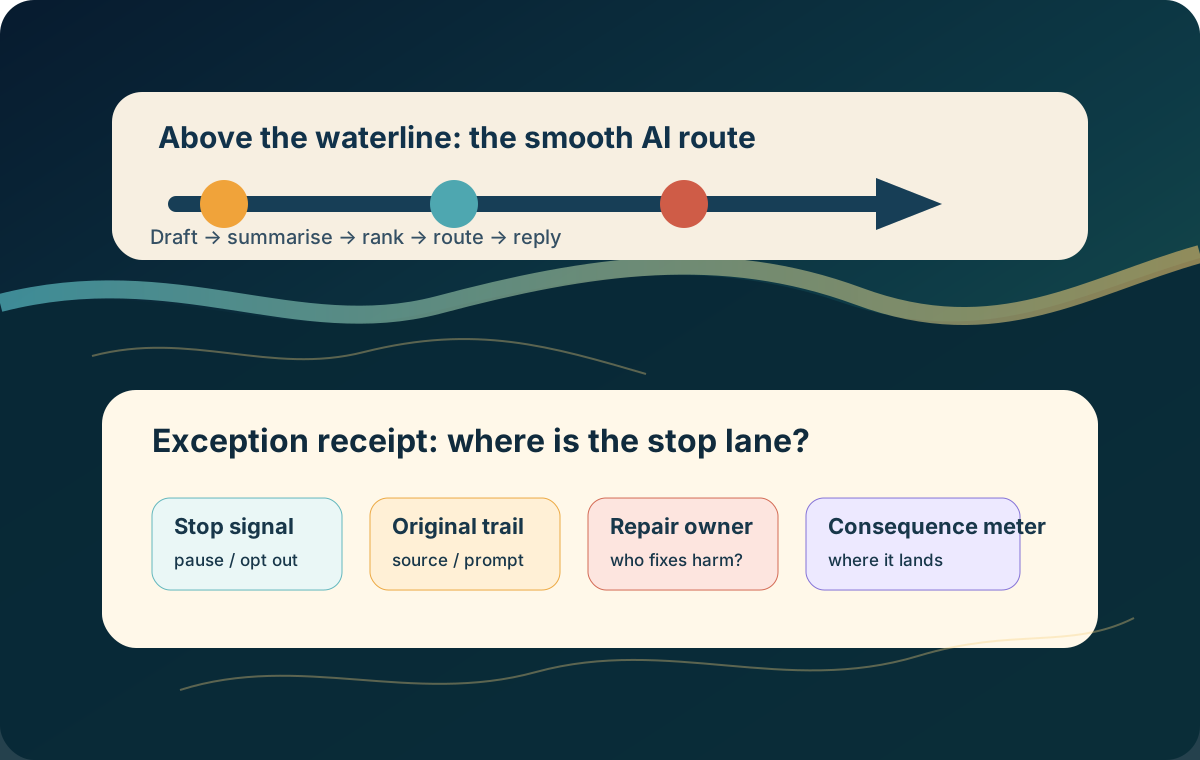
AI defaults become harder to govern when the shortcut works often enough that people forget to design the pause, challenge and repair route.
Before accepting an AI workflow as normal, ask what it does first, where the stop signal sits, how to inspect the original trail, who repairs errors and where the output lands.
The real test of an AI workflow is not the happy path. It is the exception lane.
A chatbot writes a tidy support reply. A meeting assistant produces the record. A search answer gives one confident paragraph. A ranking board names the “best” model. A workplace copilot rewrites a draft before anyone sees the original. Most of the time, the shortcut looks useful. The boiling-frog question is what happens when the shortcut is wrong, incomplete, disputed or too consequential to glide through.
That is the AI exception receipt: the small set of checks that should travel with any AI default so people can pause, challenge, reroute or repair the output before it becomes normal infrastructure.
Why this matters now
Four current signals make the exception lane feel urgent:
- AI is no longer a side experiment. Stanford HAI’s 2025 AI Index reports that 78% of organisations said they used AI in 2024, up from 55% the year before. Once a tool is widespread, rare mistakes are no longer rare in absolute numbers.
- The spread is task-shaped, not job-title-shaped. Anthropic’s Economic Index says AI touches at least a quarter of tasks in more than a third of occupations. Exceptions often appear at the task boundary: a draft sent too early, a summary missing context, a ranking treated as neutral.
- Model testing is moving upstream. NIST’s CAISI announced May 2026 frontier-model testing agreements. That is a useful test kitchen, but the everyday exception still happens downstream inside a school tool, council service, support queue, search layer or office suite.
- The infrastructure is getting heavier. The IEA projects data-centre electricity demand rising from roughly 460 TWh in 2022 to 945 TWh by 2030. When AI becomes rented plumbing, readers need to know where the stop valve is.
The now-story is not just “AI is being adopted.” It is: AI defaults are spreading faster than the visible exception lanes around them.
The everyday analogy
Think of a bus route.
The route map tells you where the bus is meant to go on a normal day. But the useful system also needs diversions, stop-request buttons, lost-property records, complaint routes, replacement buses and a driver who can say, “this road is blocked.”
AI defaults need the same thing. A slick answer, summary or recommendation is the bus route. The exception receipt is the stop lane: how a person spots a wrong turn, pauses it, finds the original route, and gets a remedy.
The five-line exception receipt
Before letting an AI-shaped workflow become the normal route, ask for this receipt:
| Receipt line | Plain-English test | Reader question |
|---|---|---|
| Default route | What does the tool now do first, automatically or by social expectation? | Did AI become the starting point, or only an optional aid? |
| Stop signal | How can a person pause, opt out, escalate or ask for a human route? | Is the stop button visible before the output has already moved on? |
| Original trail | What source, transcript, document, prompt or data can be checked? | Can someone compare the shortcut with the road it replaced? |
| Repair owner | Who fixes a wrong summary, ranking, reply, decision or record? | Is responsibility with a human team, a vendor queue or nobody obvious? |
| Consequence meter | Where does the output land next, and who is affected? | Is this low-risk convenience, or does it touch grades, jobs, benefits, healthcare, reputation or money? |
This is not anti-automation. It is pro-reversibility. A good AI shortcut should make the ordinary route faster without making the exceptional case invisible.
Where to use it tomorrow
- In support: ask whether an AI-drafted answer includes an escalation path before it reaches an angry customer.
- In meetings: ask whether the AI summary preserves disputed points and links back to the transcript.
- In schools: ask whether AI feedback can be overridden by a teacher with the pupil’s actual work in view.
- In hiring: ask whether a shortlist can be challenged with visible criteria and exclusion notes.
- In search: ask whether the answer layer points back to sources, omissions and uncertainty.
- In model leaderboards: ask whether “best” means best for this task, this cost, this openness requirement and this downstream setting.
The boiling-frog risk is that the default route becomes so smooth that nobody budgets for the diversion. The reader’s move is simple: when AI becomes the shortcut, ask where the exception lane is.
Boiling Frogs lens: judge AI defaults by their exception receipts: default route, stop signal, original trail, repair owner and consequence meter.
Sources: Stanford HAI 2025 AI Index, Anthropic Economic Index, NIST / CAISI frontier-model testing agreements, IEA Energy and AI.