
The AI evidence sandwich: do not trust the answer without the filling
A practical current-news lens for reading AI claims: put every impressive output between its source trail, human handoff and infrastructure bill before calling it useful.
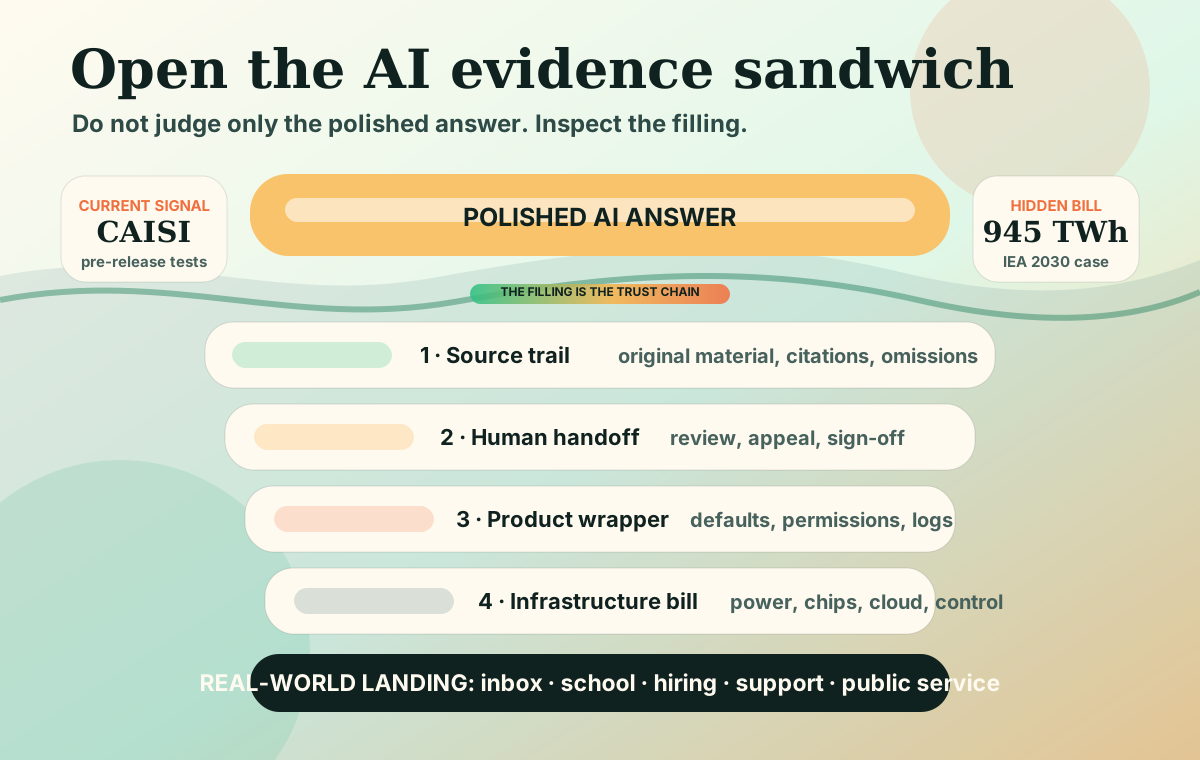
AI outputs become more persuasive as they get faster and smoother, so readers need to inspect the trust chain underneath the answer.
Before trusting an AI summary, ranking or recommendation, ask for the source trail, human handoff, deployed-product wrapper and hidden infrastructure bill.
The easiest AI mistake is to judge the answer on the plate.
It looks fluent. It arrives quickly. It sounds confident enough to move the meeting along. That is why the better question is not “was the output impressive?” It is “what is the filling between the top slice and the bottom slice?”
Think of every AI claim as an evidence sandwich:
- Top slice: the answer — the neat paragraph, ranking, summary, image, spreadsheet, recommendation or model score.
- Filling: the chain of trust — sources, permissions, assumptions, tests, handoffs, costs and accountability.
- Bottom slice: the real-world landing place — the inbox, classroom, hiring desk, support queue, public service, news feed or energy system where somebody lives with the result.
If the filling is missing, the sandwich is just bread.
Why this matters now
AI is moving from spectacular demonstrations into ordinary default settings. That makes the evidence layer more important, not less.
Read three current signals together:
- Evaluation is moving upstream. NIST’s CAISI announced pre-release frontier-model testing agreements in May 2026. Useful signal: labs and evaluators are moving closer to the kitchen. Reader question: what exactly was tested, and what does that not prove about the eventual product wrapper?
- Work is changing by task, not by headline. Anthropic’s Economic Index frames AI exposure as drafts, summaries, comparisons, code scaffolds and analysis steps moving inside jobs before the job title changes. Reader question: which human judgement now arrives pre-shaped?
- The answer box has pipes. The IEA’s Energy and AI report projects data-centre electricity demand rising from about 460 TWh in 2022 to around 945 TWh by 2030. Reader question: who pays for the hidden machinery, and who controls access when intelligence becomes rented infrastructure?
The boiling-frog move is to stop treating those as separate stories. They are one sandwich: capability, evidence and consequence.
The everyday analogy
Imagine a restaurant review that says only: “The meal tasted good.”
That might be enough for a casual lunch. It is not enough for a school kitchen, hospital ward, airline meal, allergy-safe menu or public contract. In those settings, the visible plate is only the start. You need ingredients, handling, temperature checks, supplier records, who signed off, and what happens if someone is harmed.
AI works the same way. The higher the stakes, the more the reader needs the recipe card behind the result.
The four-filling test
Use this quick receipt before trusting an AI-shaped answer, ranking or workflow:
| Filling layer | Plain-English test | Reader question |
|---|---|---|
| Source trail | Can I inspect the original material, or only the polished conclusion? | What would change my mind if the answer is wrong? |
| Human handoff | Did a person choose, review, approve or appeal the result? | Where does responsibility re-enter the workflow? |
| Product wrapper | Was the real deployed tool tested, or only the underlying model? | Which permissions, defaults and data changed after the lab test? |
| Infrastructure bill | What physical, financial or platform dependency sits under the interface? | Who carries the cost and who gains control? |
This is not a call to reject AI. It is a call to read it like a grown-up system rather than a magic box.
Where to use it tomorrow
- At work: when an AI summary frames a meeting, ask which documents were included, which were missing and who checked the interpretation.
- In school: when a student produces polished work, ask what they can explain without the tool and what sources they can defend.
- In hiring: when a screening tool ranks candidates, ask which evidence is visible, appealable and audited.
- In customer support: when a bot escalates a case, ask whether the human sees the bot’s assumptions or only its recommendation.
- In AI rankings: when a model is “best”, ask best for which task, at what cost, using which benchmark, with which openness.
- In public debate: when AI is described as inevitable, ask who benefits from making the default feel irreversible.
The point is simple: do not argue with the bread. Open the sandwich.
Boiling Frogs lens: the next stage of AI literacy is evidence literacy. A reader should be able to see not only the answer, but the chain underneath it: source, handoff, wrapper, cost and consequence.
Sources: NIST / CAISI frontier-model testing agreements, Anthropic Economic Index, IEA Energy and AI.