
The AI escalation receipt: where does the machine hand back?
A plain-English briefing for spotting whether an AI shortcut has a real human hand-back point before the output becomes a record, route or decision.
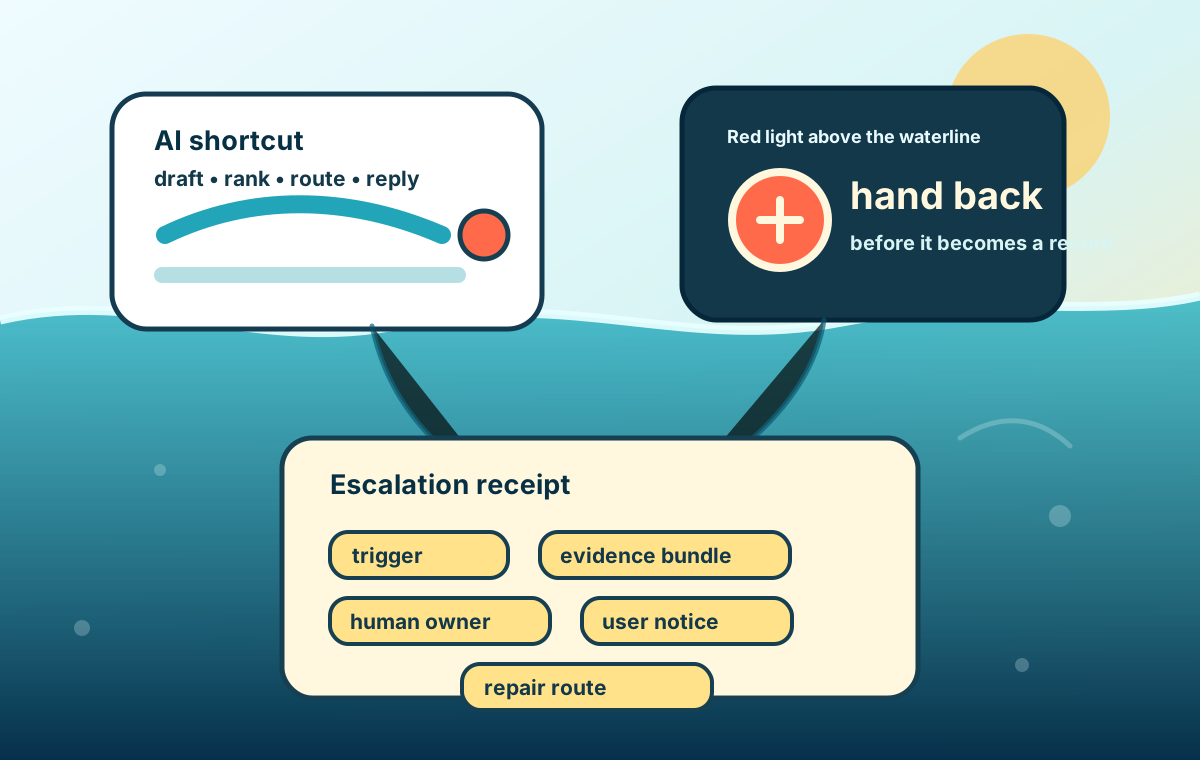
AI workflows become risky when outputs can become replies, records, routes or decisions before a visible human hand-back point exists.
When an AI shortcut looks frictionless, ask what triggers escalation, what evidence travels, who owns review, whether the user is told and how mistakes are repaired.
AI systems are getting smoother at the exact moment readers need to ask a blunt question: where does the machine hand back?
The risky shift is not only that an AI can draft, rank, summarise, triage or recommend. It is that the output can move one step further — into a customer reply, school note, support queue, meeting record, hiring screen, code review, dashboard or public-service file — before anybody knows what evidence travelled with it.
That is why ordinary AI literacy now needs an AI escalation receipt: a short visible label for the moment when an AI result should stop being automatic and become inspectable by a person.
Why this matters now
Three current signals make escalation more than a safety-team word:
- AI is spreading at task level, not job-title level. Anthropic’s Economic Index found AI touching at least a quarter of tasks in 36% of occupations. The everyday version: the first AI hand-back point is likely to sit inside an ordinary task — a draft, ranking, summary or queue — not inside a dramatic robot takeover.
- Governance guidance keeps pointing at human oversight. The NIST AI Risk Management Framework centres govern, map, measure and manage as a loop. That sounds abstract until it becomes a practical question: what evidence tells a worker, teacher, manager or citizen that this output needs a human check?
- AI incidents are becoming a public record. The OECD AI Incidents Monitor tracks reports where AI systems are linked to real-world harms, failures or disruptions. The ordinary-reader lesson is simple: once AI outputs start moving through real services, organisations need a visible way to pause, escalate and repair.
The boiling-frog risk is a workflow that works well enough most of the time. Because it usually works, the escalation lane gets skipped, hidden or designed after the damage has already become someone’s record.
The everyday analogy
Think of a supermarket self-checkout.
Most scans are routine. But the machine still needs a red light for age checks, missing barcodes, double scans, bagging errors, refunds and suspicious totals. Without that light, the queue might look faster while the dispute moves to the customer, the staff member or the receipt after the fact.
AI workflows need the same red light. Not panic. Not a committee for every sentence. A clear hand-back point when confidence, consequence, evidence or complaint risk crosses a line.
The five-line escalation receipt
Use this receipt whenever an AI system summarises, routes, scores, replies, recommends or files something that another person may treat as real:
| Receipt line | Plain-English test | Reader question |
|---|---|---|
| Trigger | What makes the shortcut stop? | Low confidence, missing source, sensitive topic, high consequence, user challenge, unusual pattern or policy mismatch? |
| Evidence bundle | What travels to the human reviewer? | Original source, model output, prompt/context, data timestamp, confidence signal, policy rule and change history? |
| Human owner | Who is allowed to override it? | Named role, queue, teacher, manager, clinician, support lead, procurement owner or public-service caseworker? |
| User notice | Does the affected person know? | Can the person see that AI helped shape the answer, score, route or record — and how to challenge it? |
| Repair route | What happens after escalation? | Correct the record, notify downstream users, log the incident, update the rule, roll back the shortcut or compensate harm? |
This is not a demand to remove automation. It is a demand to make automation honest about its edge cases.
Where it lands tomorrow
- In support queues: an AI reply should escalate when the customer disputes facts, the issue involves money or the source trail is thin.
- In schools: an AI feedback note should escalate when it becomes a grade, intervention record or formal communication with a family.
- In hiring: an AI shortlist should escalate when it filters a candidate out, not after the applicant has already disappeared.
- In public services: an AI summary should escalate before it changes eligibility, priority, enforcement or a citizen’s case history.
- In model dashboards: a ranking should escalate from “best model” to human review when the task, cost, openness or evidence source is missing.
The useful habit is small but powerful: whenever an AI workflow looks frictionless, ask where the red light is.
Boiling Frogs lens: every AI shortcut needs an escalation receipt: trigger, evidence bundle, human owner, user notice and repair route.
Sources: Anthropic Economic Index, NIST AI Risk Management Framework, OECD AI Incidents Monitor.