
The AI delegation receipt: what did you just let the system do?
A plain-English June briefing for checking AI helpers before they move from suggesting to acting: task, authority, evidence, pause point and log.
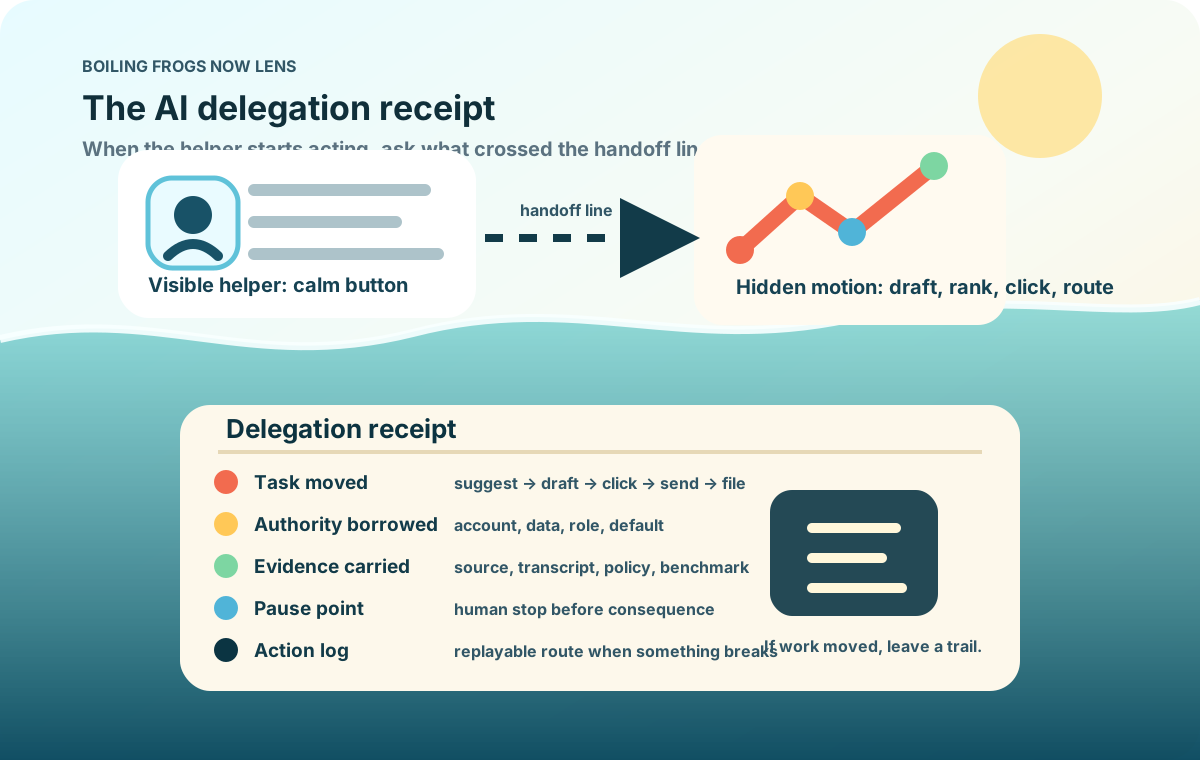
AI helpers become harder to govern when they cross from suggesting into drafting, ranking, clicking, routing or sending without a visible handoff trail.
Before letting an AI assistant act, ask what task moved, whose authority it borrowed, what evidence travelled, where a person can pause it and what log remains.
The quiet AI shift is no longer just better answers. It is delegated motion.
A copilot drafts the email. A meeting assistant writes the record. A search assistant answers before you choose a source. A workplace agent opens the browser, books the slot, edits the file or routes the ticket. The interface still looks calm, but the system has crossed a line: it is no longer only advising a person; it is carrying part of the work.
That calls for an AI delegation receipt: a simple way to ask what you just allowed the system to do on your behalf.
Why this matters now
Four current signals make delegation a practical literacy problem rather than a future scenario:
- AI is already normal inside organisations. Stanford HAI’s 2025 AI Index reports that 78% of organisations said they used AI in 2024, up from 55% a year earlier. Once use is normal, the important question becomes which tasks are being quietly handed over.
- The spread is task-shaped. Anthropic’s Economic Index says AI touches at least a quarter of tasks in more than a third of occupations. Delegation is easiest to miss when it arrives as one harmless step: summarise this, rank these, draft that, escalate this case.
- Testing is moving upstream, but use happens downstream. NIST / CAISI’s 2026 frontier-model testing agreements bring evaluators closer to the model kitchen. Helpful — but ordinary users still meet the system inside product wrappers with permissions, defaults and workflow shortcuts.
- The infrastructure bill is not imaginary. The IEA projects data-centre electricity demand rising from roughly 460 TWh in 2022 to 945 TWh by 2030. A tiny “do it for me” button can sit on top of a large stack of chips, cloud contracts, energy demand and platform control.
The now-story is not that every AI assistant is dangerous. It is that delegation is becoming too smooth to notice.
The everyday analogy
Think of handing someone your house keys while you are on the phone.
If they only give advice, the risk is limited. If they unlock the door, move a parcel, sign for a delivery and leave a note, you want a receipt: which task, which permission, what evidence, where they paused and what record remains.
AI delegation needs the same receipt. The smoother the helper feels, the more visible the handoff should be.
The five-line delegation receipt
Before letting an AI helper act inside a workflow, ask for this receipt:
| Receipt line | Plain-English test | Reader question |
|---|---|---|
| Task moved | What exact step did the system take over? | Did it only suggest, or did it draft, rank, click, send, file, book, buy or escalate? |
| Authority borrowed | Which account, data, permission or role did it use? | Was it acting with my access, my organisation’s access or a hidden platform default? |
| Evidence carried | What source trail travelled with the action? | Can I see the documents, transcript, policy, benchmark or customer record behind it? |
| Pause point | Where could a human stop, edit or reject the action? | Is approval before the consequence, after it, or nowhere obvious? |
| Action log | What durable record remains? | If something goes wrong, can the route be replayed by a person who was not there? |
This is not a call to ban useful AI automation. It is a way to stop “helpful” becoming “uninspectable”.
Where to use it tomorrow
- In email: ask whether the generated reply shows the policy source and waits for approval before sending.
- In meetings: ask whether the AI summary distinguishes transcript, interpretation and action items before it becomes the record.
- In support queues: ask whether the bot’s escalation route and evidence trail are visible to the human agent.
- In hiring: ask whether ranking and screening tools preserve criteria, rejected evidence and review notes.
- In schools: ask whether AI feedback remains teacher-checkable before it shapes a student’s next move.
- In model leaderboards: ask whether a “best model” choice carries task fit, cost, openness and downstream use — not just a rank.
The boiling-frog risk is delegation without a handoff slip. Each shortcut feels reasonable. Then one day the system is moving work, records and responsibility faster than people can inspect.
Boiling Frogs lens: treat AI helpers like delegated actors. Ask what task moved, whose authority it borrowed, what evidence travelled, where the pause point sits and what log remains.
Sources: Stanford HAI 2025 AI Index, Anthropic Economic Index, NIST / CAISI frontier-model testing agreements, IEA Energy and AI.