
AI defaults are the new waterline
The quiet AI shift is not only better models. It is AI moving into default settings, office habits, infrastructure bills and everyday decisions before most people realise the room has changed.
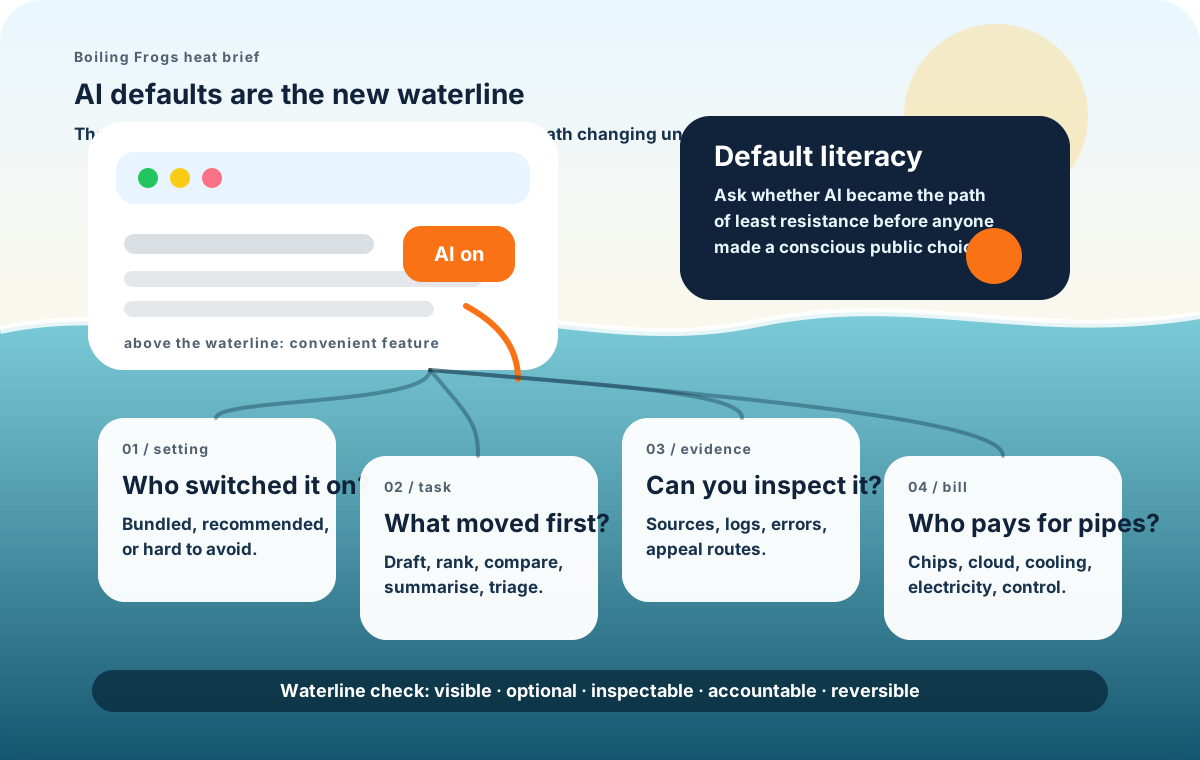
AI becomes harder to debate when it moves from optional feature to default starting point inside familiar software and services.
When a tool says AI is built in, ask whether it is visible, optional, inspectable, accountable and reversible.
The loud AI story is still the launch: a new model, a faster demo, a sharper benchmark chart.
The warmer-water story is quieter: AI is becoming a default. It appears inside the software people already use, in the first draft before the human writes, in the answer box before the source list, and in the cloud bill before anyone calls it infrastructure.
That is why the useful reader question is changing from “Can AI do this?” to “Where did AI become the starting point?”
The default test
A feature is one thing. A default is different. A feature asks to be noticed. A default shapes behaviour while feeling like the normal path.
Use this four-part receipt when a product, employer, school or public service says AI is now built in:
| Default layer | What changed | Reader question |
|---|---|---|
| Setting | AI is switched on, bundled, recommended or hard to avoid. | Who chose the default, and can ordinary users turn it down? |
| Task | Drafting, ranking, summarising, comparing or triaging moves to a machine first. | Which judgement now arrives pre-framed for the human? |
| Evidence | The answer feels complete before the source trail is checked. | What would change my mind, and can I still inspect the original evidence? |
| Bill | The friendly interface depends on chips, cloud contracts, electricity and cooling. | Who pays for the hidden infrastructure, and who controls access to it? |
The boiling-frog problem is not that every default is bad. It is that defaults are powerful precisely because they do not feel dramatic.
Three current signals to read together
One statistic rarely tells the full story. Read the signals as a system:
- Adoption: Stanford HAI’s 2025 AI Index reports that organisational AI use rose to 78% in 2024, up from 55% a year earlier. The everyday implication is simple: even non-users increasingly meet AI through workplaces, vendors, schools, services and software updates.
- Work habits: Anthropic’s Economic Index frames workplace AI as task-level change: drafts, summaries, comparisons, code scaffolds and analysis steps moving before whole job titles do. The visible sign may be a faster report, not a redundancy notice.
- Infrastructure: The IEA’s Energy and AI report says data-centre electricity demand could rise from about 460 TWh in 2022 to around 945 TWh by 2030. The answer box feels weightless because the heavy machinery is somewhere else.
Put together, those signals describe a new waterline. AI is not only a tool people choose. It is becoming part of the room: the office suite, the search result, the support queue, the classroom workflow, the design brief, the procurement pitch and the energy plan.
The supermarket analogy
Think of the self-checkout lane.
At first it is optional. Then there are fewer staffed tills. Then the layout points you towards the machine. Then the queue makes the choice for you. Eventually the question is no longer “Do I want self-checkout?” It is “Why is there only one person on the till?”
AI defaults can move in the same way. A writing assistant starts as a button. Then the first draft appears automatically. Then the performance expectation assumes faster output. Then the person who does not use it looks slow, even if their process is more careful.
That is the heat to watch: not the tool, but the expectation forming around the tool.
Where readers will feel it first
The new waterline is most visible in ordinary rooms:
- Inbox: replies arrive polished, prioritised and summarised before the relationship catches up.
- Classroom: the bottleneck moves from producing text to proving understanding.
- Hiring desk: AI-shaped CVs meet AI-shaped screening, while both sides still call the process human.
- Support queue: the bot no longer just answers; it triages, escalates and writes the human agent’s next move.
- Search result: the answer arrives before the trail, making convenience feel like confidence.
- Local infrastructure: data centres, energy planning and platform contracts become part of the public AI story.
The practical move
Do not ask only whether AI is impressive. Ask whether it has become the path of least resistance.
When a new AI feature appears in a familiar setting, run the waterline check:
- Is it visible? Can people tell when AI shaped the output?
- Is it optional? Can they refuse without being penalised by time, cost or status?
- Is it inspectable? Can they see sources, logs, assumptions and error paths?
- Is it accountable? Is there a person or institution responsible when the output harms someone?
- Is it reversible? Can the workflow be paused, appealed, corrected or rebuilt?
The future does not have to arrive as a robot at the door. Sometimes it arrives as the default button already pressed.
Boiling Frogs lens: the next phase of AI awareness is default literacy. Watch where AI becomes the starting point, who benefits from that setting, and what ordinary people lose when the old path quietly disappears.
Sources: Stanford HAI AI Index 2025, Anthropic Economic Index, IEA Energy and AI.