
The AI benchmark receipt: what did the scoreboard really measure?
A plain-English briefing for reading AI model rankings as receipts, not horse races.
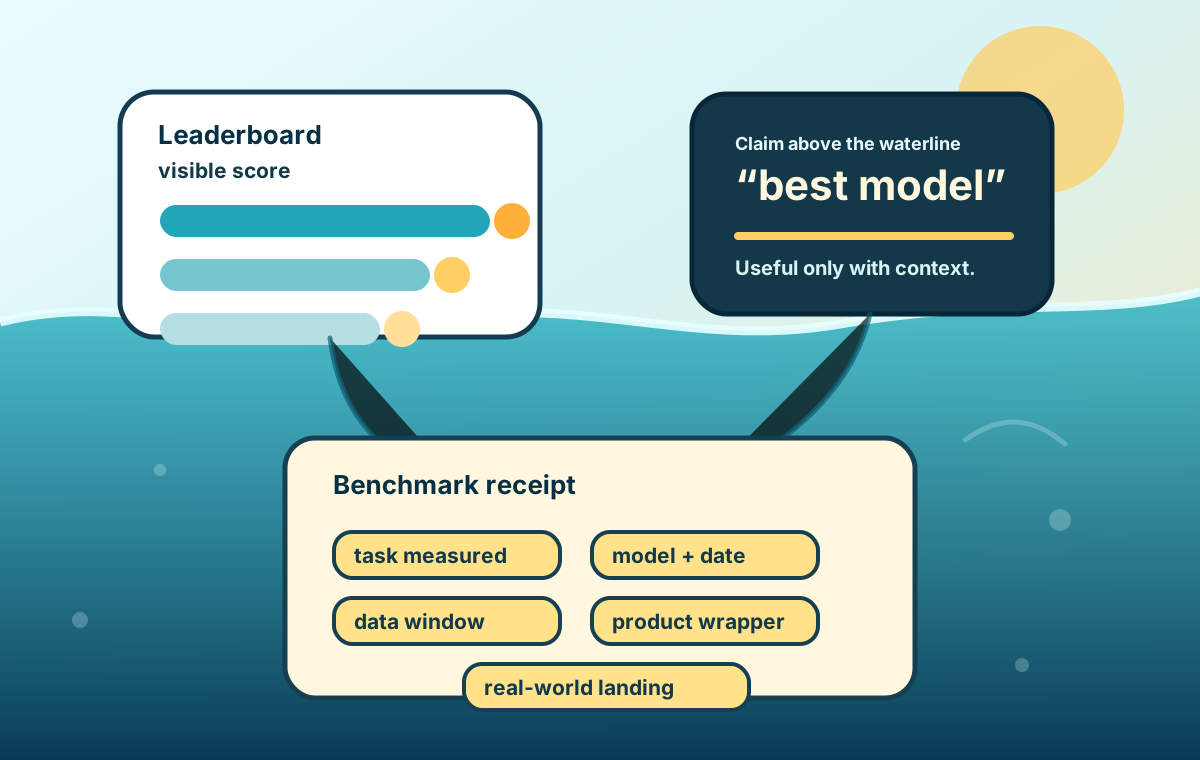
AI rankings become risky when a clean benchmark score is treated as proof that a repackaged product is right for every downstream task.
When a model is called best, ask what task was measured, which model and date were scored, what data window was used, what wrapper changed and where the output lands.
AI leaderboards are useful. They are also easy to misread.
A model can sit at the top of a chart for maths, coding, reasoning, multimodal tasks or agent-style tool use, then arrive inside a workplace product as a very different thing: wrapped in a prompt, filtered by policy, priced by usage, connected to company data, and updated without the user seeing the scoreboard change.
That is why every AI ranking needs an AI benchmark receipt. Not a long academic appendix. A small visible label that says what was measured, how fresh it is, what changed after deployment, and where the result will land in real life.
Why this matters now
Three signals make benchmark literacy part of everyday AI literacy:
- AI performance is moving fast enough that scores become a moving target. Stanford HAI’s 2025 AI Index tracks rapid gains across frontier capabilities and notes that AI systems are becoming more capable, cheaper to use and more widely deployed. The ordinary-reader version: yesterday’s “best model” claim may already need a date stamp.
- Evaluation is moving upstream into the supply chain. NIST/CAISI’s 2026 frontier-model testing agreements show governments trying to inspect models closer to release. That is progress — but a pre-release test is not the same as proof that every downstream product wrapper is safe, fair or auditable.
- Workplace use changes the unit of risk from model to task. Anthropic’s Economic Index found AI touching at least a quarter of tasks in 36% of occupations. A benchmark may test a model on a clean task; a user meets it as a summary, ranking, draft, route or decision aid inside messy work.
The boiling-frog risk is not that leaderboards exist. It is that a neat score becomes a universal trust signal after the model has been repackaged, connected, constrained, updated and aimed at consequential tasks.
The everyday analogy
Think of a car’s safety rating.
A five-star test matters, but it does not tell you whether this exact car has the right tyres, software update, child seat, driver, road conditions, insurance, maintenance record or recall notice. You still want the test result. You just do not treat it as the whole driving receipt.
AI benchmark claims need the same habit. The score is the crash-test headline. The receipt is the model version, task, data window, product wrapper, human checkpoint and real-world consequence.
The five-line benchmark receipt
Use this receipt whenever a product, dashboard or vendor says a model is “best”, “safer”, “more capable” or “state of the art”:
| Receipt line | Plain-English test | Reader question |
|---|---|---|
| Task measured | What job did the benchmark actually test? | Coding, maths, writing, retrieval, tool use, images, safety refusal, long context or agent planning? |
| Model and date | Which exact model/version was scored, and when? | Is this the same model now inside the product, or a near cousin with a newer label? |
| Data window | What evidence fed the score? | Public benchmark, private eval, human preference vote, production telemetry, red-team run or vendor claim? |
| Product wrapper | What changed after the model left the test bench? | System prompt, filters, tools, memory, files, search, permissions, price tier, rate limit or enterprise controls? |
| Landing place | What consequence does the output create? | Inbox draft, code merge, school feedback, support answer, model leaderboard, hiring shortlist or public-service note? |
This does not mean readers should ignore benchmark tables. It means they should read them like weather maps: useful, current, conditional and local only after you ask where you are standing.
Where it lands tomorrow
- In model dashboards: check whether the ranking shows task, source, model version, cost and freshness instead of one magic score.
- In procurement decks: ask whether “top benchmark performance” refers to the exact model, product settings and use case being bought.
- In workplaces: ask whether a model good at clean reasoning is being asked to route messy people, documents or complaints.
- In schools: ask whether the benchmarked capability matches the learning task, feedback process and teacher checkpoint.
- In media coverage: ask whether the headline says what improved, or only that a new model “beat” a rival.
The useful habit is simple: keep the scoreboard, but ask for the receipt before the score becomes a decision shortcut.
Boiling Frogs lens: whenever an AI ranking looks definitive, ask for the benchmark receipt: task measured, model and date, data window, product wrapper, and landing place.
Sources: Stanford HAI 2025 AI Index, NIST/CAISI frontier-model testing agreements, Anthropic Economic Index.