
The AI autopilot receipt: when help becomes the default route
A plain-English June briefing on the quiet shift from AI as an optional helper to AI as the route ordinary work is expected to take.
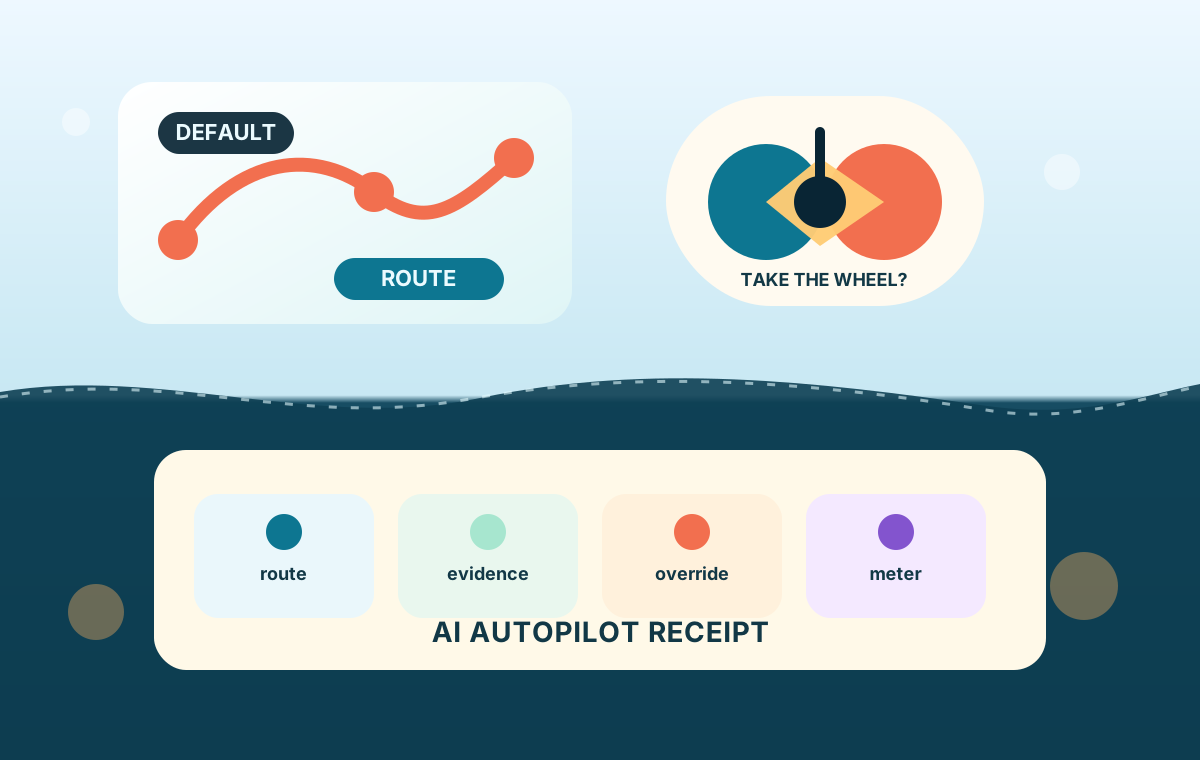
AI assistance becomes harder to inspect when it shifts from optional helper to the path of least resistance inside everyday workflows.
Before accepting an AI-assisted workflow as normal, ask what route became default, what evidence stayed visible, where the override sits and who pays when the shortcut scales.
The most important AI setting is often not labelled AI.
It is the small default that says: summarise this meeting, draft this reply, rank these options, fill this form, suggest this answer, route this case. Nothing looks dramatic. The interface still feels familiar. But the route through the work has changed.
That is the AI autopilot receipt: a quick way to ask what moved from human-first to software-first, what evidence travelled with the move, and where a person can still take the wheel.
Why this matters now
Three current signals make the autopilot question sharper:
- AI is entering tasks before job titles change. Anthropic’s Economic Index frames adoption around work activities: drafting, coding, comparing, summarising, analysing and translating. It says AI touches at least a quarter of tasks in more than a third of occupations. The quiet unit of change is not “the job”; it is the task route.
- Testing is moving upstream, but products land downstream. NIST’s CAISI announced May 2026 pre-release testing agreements with frontier AI developers. That is useful. But ordinary readers still need to ask whether the tested model is the same thing as the product wrapper in a school, office, hiring tool or public service.
- The answer box has a meter attached. The IEA’s Energy and AI report projects data-centre electricity demand rising from about 460 TWh in 2022 to about 945 TWh by 2030. Autopilot may feel frictionless at the screen, but it is not weightless in the world.
Put those together and the current AI story is not just capability. It is routing: who sets the path of least resistance, who sees the route, who pays for it, and who can still override it.
The everyday analogy
Think about a satnav.
At first it is a helpful suggestion. Then it becomes the route everyone follows by default. Shops change delivery times around it. Drivers stop learning side roads. A closed bridge or bad traffic model can send hundreds of people the same wrong way.
AI defaults work the same way. A draft suggestion can become the office tone. A model ranking can become the shortlist. A search answer can become the source. A meeting summary can become the memory. The danger is not that every route is wrong. The danger is that the route becomes invisible.
The four-line autopilot receipt
Before accepting an AI-assisted workflow as normal, ask for this receipt:
| Receipt line | Plain-English test | Reader question |
|---|---|---|
| Default route | What did the tool make easiest: draft, rank, summarise, approve, escalate, buy, code or publish? | Is AI optional help, or the path everyone is nudged onto? |
| Route evidence | What sources, assumptions, logs and omissions are visible after the output appears? | Could a person reconstruct why this route was chosen? |
| Override point | Where can a human pause, compare, correct, appeal or choose a different path? | Is taking the wheel easy, or socially and technically awkward? |
| Real-world meter | What cost, dependency or downstream effect sits outside the interface? | Who pays the bill if the default scales? |
This is not anti-automation. Autopilot can reduce busywork. But a good autopilot has a dashboard, a warning light, a manual override and a logbook.
Where to use it tomorrow
- In meetings: ask whether the AI summary became the official memory, and whether disagreement or missing documents stayed visible.
- In support queues: ask whether the suggested answer shapes the human agent before the customer is understood.
- In hiring: ask whether a ranker decides who gets attention first and whether candidates can challenge the evidence.
- In classrooms: ask whether AI feedback is a learning prompt or the route students are expected to follow.
- In public services: ask whether a tool speeds up triage while making the appeal path harder to find.
- In model rankings: ask whether “best” means best for the route you actually need, at the cost you can defend.
The boiling-frog risk is that autopilot becomes normal one helpful shortcut at a time. By the time anyone asks who chose the route, the organisation may already be built around it.
Boiling Frogs lens: do not just ask whether AI helped. Ask what route it made default, what evidence remained visible, where the override sits and who pays when the shortcut scales.
Sources: Anthropic Economic Index, NIST / CAISI frontier-model testing agreements, IEA Energy and AI.