
The AI audit-trail receipt: when a polished answer needs a paper trail
A plain-English June briefing on why AI answers, summaries and rankings need a visible audit trail: source, model, handoff, human check and consequence.
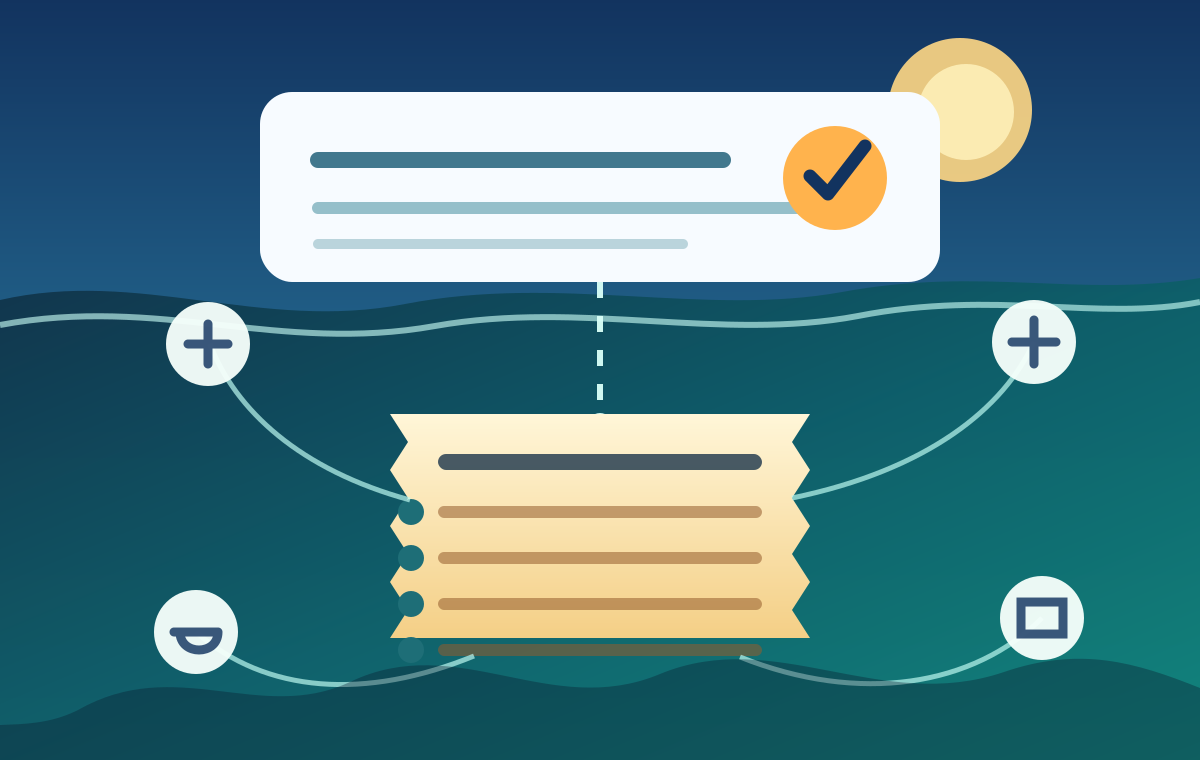
AI answers, summaries and rankings become riskier when they look finished but the source trail, product wrapper and human checkpoint are invisible.
Before accepting a polished AI output as proof, ask what sources fed it, which system shaped it, who checked it, what changed and where the result lands next.
The AI output that feels most finished is often the one most in need of a receipt.
A meeting summary lands in the shared folder. A model ranking decides which tool a team buys. A support assistant drafts the reply. A classroom feedback tool tells a pupil what to fix. A search answer compresses ten sources into one paragraph. Everyone sees the polished top layer. Fewer people see the trail underneath.
That is the AI audit-trail receipt: a quick way to ask whether an AI-made or AI-shaped result can be checked after it has moved into real work.
Why this matters now
Four current signals make the audit-trail question sharper:
- AI is already inside ordinary organisations. Stanford HAI’s 2025 AI Index reports that 78% of organisations said they used AI in 2024, up from 55% the year before. That means the question is no longer “will AI arrive?” It is “which outputs are already becoming records, recommendations and first drafts?”
- The spread is task-shaped. Anthropic’s Economic Index says AI touches at least a quarter of tasks in more than a third of occupations. The audit trail matters because the handoff is often small: summarise, compare, rank, route, draft, translate or escalate.
- Testing is moving upstream. NIST’s CAISI announced May 2026 frontier-model testing agreements. Upstream testing is useful, but a reader still needs the downstream receipt: which product version, which setting, which human checkpoint and which real-world use?
- The answer box has infrastructure behind it. The IEA projects data-centre electricity demand rising from roughly 460 TWh in 2022 to 945 TWh by 2030. If AI becomes a normal public utility, the trail should show not only what it said, but what system produced it and who can contest it.
The now-story is not just “AI is getting better.” It is: AI outputs are becoming organisational memory, decision scaffolding and public-facing explanations before the evidence trail is equally normal.
The everyday analogy
Think of a parcel delivery slip.
The parcel at the door is the visible result. The useful information is the trail: who sent it, where it passed through, when it was handed over, who signed, and what happens if it arrived damaged or wrong.
AI answers need the same habit. A neat summary, ranking or recommendation is the parcel. The audit trail is the delivery slip. Without it, people inherit the output but not the route it travelled.
The five-line audit-trail receipt
Before treating an AI-shaped output as finished, ask for this receipt:
| Receipt line | Plain-English test | Reader question |
|---|---|---|
| Source stack | What documents, data, links or prompts fed the result? | Could a human inspect the original trail, not just the final summary? |
| System wrapper | Which model, tool, product setting or policy shaped the answer? | Was this the raw model, a workplace app, a school tool, a search layer or a vendor dashboard? |
| Human checkpoint | Where did a person review, correct or accept the output? | Was the check meaningful, or just a rubber stamp after the work had moved on? |
| Change log | What edits, confidence notes, uncertainty and corrections remain visible? | Can someone see what was uncertain or later fixed? |
| Consequence route | Where did the output land next: record, reply, shortlist, grade, ticket or policy note? | Who is affected if the neat answer was incomplete? |
This is not paperwork for paperwork’s sake. It is how ordinary readers stop fluent AI from becoming unchallengeable authority.
Where to use it tomorrow
- In meetings: ask whether an AI summary includes the source transcript, attendance context, unresolved points and human sign-off.
- In support queues: ask whether a drafted response shows what customer history it used and what evidence would change the answer.
- In schools: ask whether AI feedback points back to the pupil’s actual work, the marking goal and a teacher checkpoint.
- In hiring: ask whether shortlists preserve criteria, exclusions, appeals and human review notes.
- In model leaderboards: ask whether the “best model” claim shows task fit, benchmark source, cost, openness and exact variant.
- In public services: ask whether an AI-assisted decision can be reconstructed by someone outside the tool vendor.
The boiling-frog risk is that polished AI output starts looking like proof. It is not proof until the route is visible.
Boiling Frogs lens: when an AI answer, summary or ranking looks finished, ask for the audit-trail receipt: source stack, system wrapper, human checkpoint, change log and consequence route.
Sources: Stanford HAI 2025 AI Index, Anthropic Economic Index, NIST / CAISI frontier-model testing agreements, IEA Energy and AI.