
The AI appeal receipt: where does a person challenge the machine?
A plain-English briefing for spotting the appeal lane behind AI rankings, summaries, triage and automated decisions.
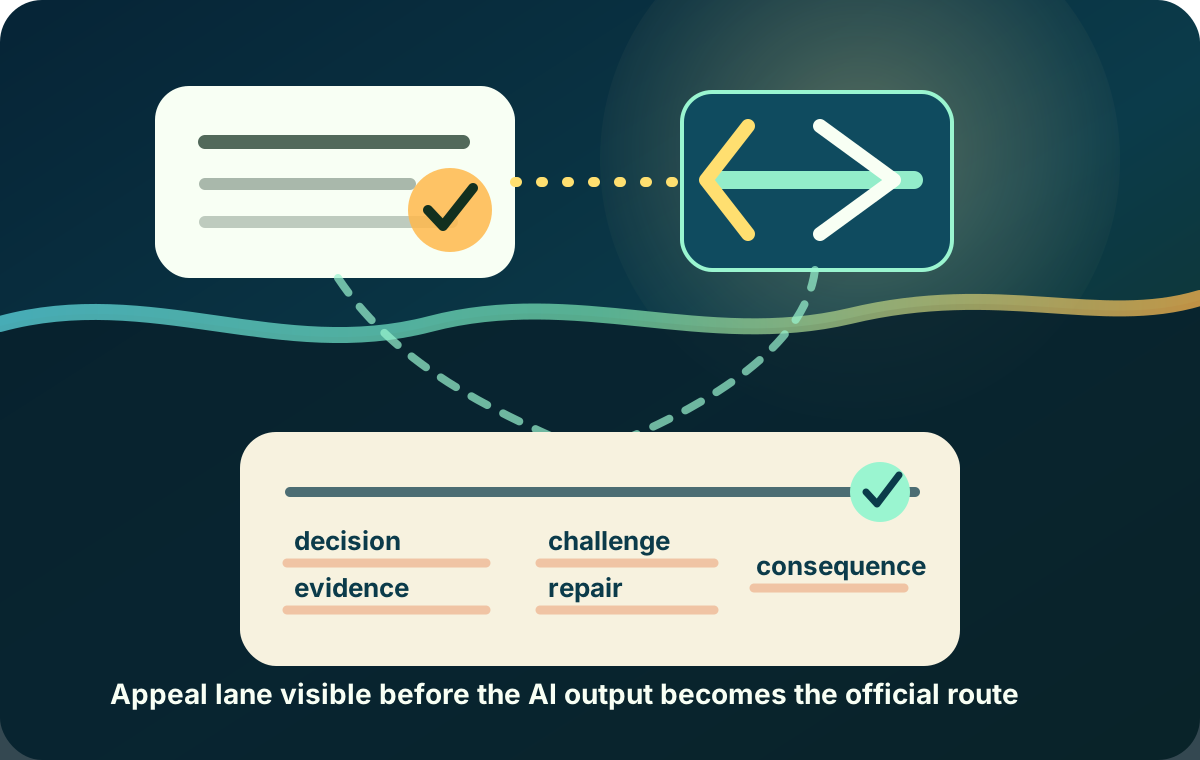
AI outputs become harder to contest when summaries, scores, flags, rankings and routes move into official records without a visible challenge point.
Before accepting an AI-assisted decision, ask what was produced, what evidence is inspectable, where someone can challenge it, who repairs the record and what changes after appeal.
The next public AI problem is not only whether a system gives a good answer. It is whether a person can challenge the answer before it hardens into a record, ranking or decision.
A search box summarises. A meeting assistant writes the memory. A support tool scores urgency. A hiring screen ranks candidates. A school product flags work. A model leaderboard says which tool is “best”. Each output can look like a helpful shortcut. But if the appeal lane is hidden, the shortcut becomes a one-way gate.
That calls for an AI appeal receipt — a small habit for asking where the human can contest the output, what evidence travels with the challenge, and who is responsible for repair.
Why this matters now
Four signals make appealability a practical literacy skill:
- AI is already ordinary workplace plumbing. Stanford HAI’s 2025 AI Index reports that 78% of organisations said they used AI in 2024, up from 55% a year earlier. At that scale, a missing appeal route is no longer a niche product flaw; it is an everyday governance gap.
- The spread is task-level, not job-title dramatic. Anthropic’s Economic Index shows AI use appearing across many occupations, especially as augmentation. The contested object may be a summary, score, draft, route or recommendation — small enough to seem harmless, strong enough to frame what happens next.
- Policy language is moving toward rights, records and risk controls. The EU AI Act, NIST AI Risk Management Framework and NIST Generative AI Profile all point toward documentation, oversight and risk management. Ordinary readers still need a simpler question: where do I press “this is wrong”?
- The infrastructure is becoming more expensive and centralised. The IEA’s Energy and AI report projects sharply rising data-centre electricity demand by 2030. As more services rent intelligence from the same kinds of cloud pipes, the appeal route matters as much as the answer route.
The boiling-frog problem is that AI decisions often arrive as convenience first, accountability later.
The everyday analogy
Think of a train ticket barrier.
When the gate opens, nobody notices the appeals process. When it refuses a valid ticket, the important question is suddenly not “is the gate clever?” It is: where is the staff member, what proof can you show, can the gate’s log be checked, and how quickly can the journey be corrected?
AI outputs need the same visible lane. If a tool ranks, summarises, flags, routes, rejects, recommends or files something about a person, there should be a way to stop at the barrier before the wrong output becomes the official route.
The five-line appeal receipt
Use this receipt whenever an AI output affects a real workflow:
| Receipt line | Plain-English test | Reader question |
|---|---|---|
| Decision object | What exactly did the AI produce? | Summary, ranking, risk flag, reply, score, route, shortlist, label or recommendation? |
| Original trail | What evidence can a person inspect? | Source documents, transcript, citations, prompt, rubric, benchmark, data version or action log? |
| Challenge point | Where can a person say “this is wrong”? | Before sending, after filing, inside the app, through a manager, by email, or only after harm is done? |
| Repair owner | Who can correct the result and the downstream record? | User, teacher, clinician, manager, service desk, vendor, public body or no named owner? |
| Consequence meter | What changes if the appeal succeeds? | Is the record amended, ranking rerun, decision reversed, model feedback logged or affected person notified? |
This is not anti-automation. It is the difference between a useful shortcut and a locked gate.
Where it lands tomorrow
- In meetings: ask whether a disputed AI summary can be corrected before it becomes the team memory.
- In support queues: ask whether a customer can challenge an urgency score or bot-written closure note.
- In hiring and school tools: ask whether the affected person can see the claim, evidence and route to correction.
- In search and research: ask whether an answer layer shows enough source trail to challenge a confident summary.
- In model dashboards: ask whether a ranking change can be traced back to benchmark source, task weighting, cost, freshness and model version.
The useful future is not AI that never makes mistakes. It is AI where mistakes meet visible evidence, named owners and fast repair lanes.
Boiling Frogs lens: whenever an AI output affects a person or workflow, ask for the appeal receipt: what was produced, what evidence is inspectable, where can someone challenge it, who repairs the record and what changes after a successful appeal?
Sources: Stanford HAI 2025 AI Index, Anthropic Economic Index, NIST AI Risk Management Framework, NIST Generative AI Profile, EU AI Act, IEA Energy and AI.