
The AI answer layer: when search stops being a list of doors
A plain-English briefing on AI answer boxes, agents and search: why the front door to information is becoming a decision layer, and what ordinary readers should check before trusting the shortcut.
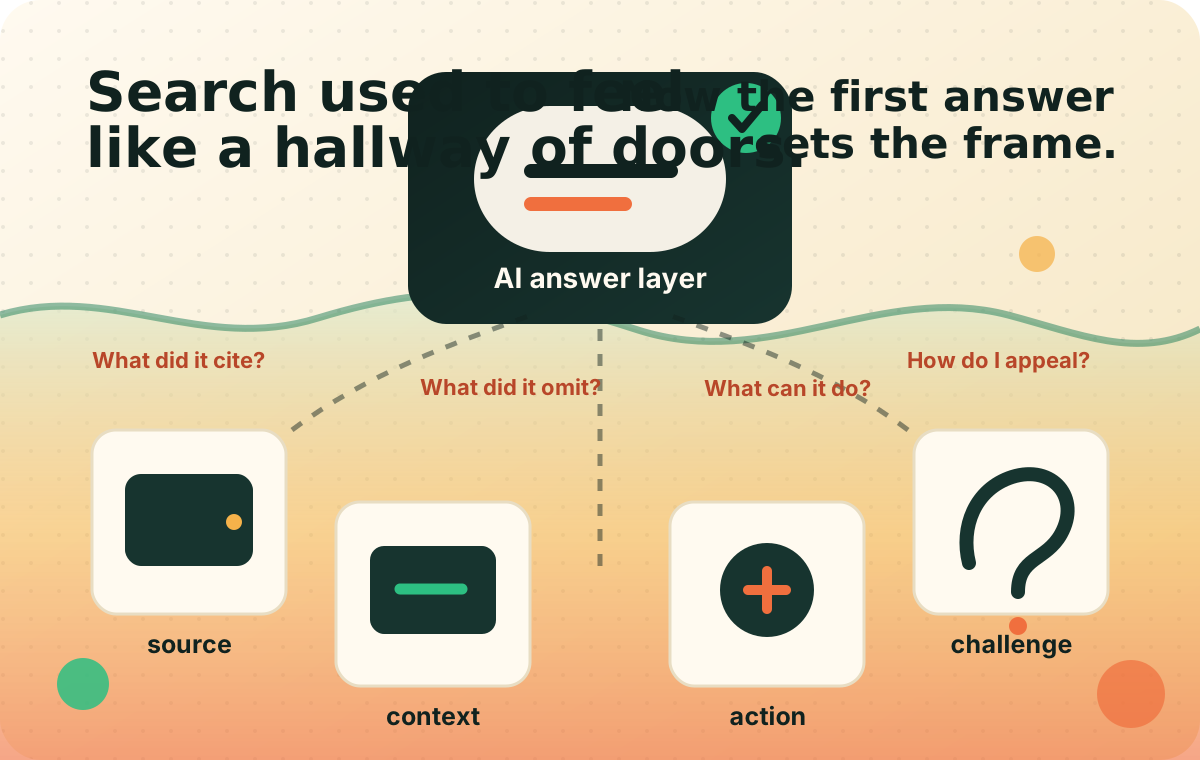
The quiet shift is from choosing between sources to accepting a framed answer before the source list is visible.
Ask what the answer cited, what it omitted, what it can do next and how a person can challenge it.
For twenty years, search felt like a hallway full of doors. You typed a question, scanned a list, chose a source, compared a few pages, and slowly built your own answer.
AI is changing that front door. Increasingly, the first thing people meet is not a list of links but a confident summary, a suggested action, a shopping answer, a homework explanation, a health-style overview, a travel plan or an agent ready to click the next button.
That sounds convenient. It is also a quiet power shift: the hallway has become a concierge.
The signal
The wider adoption numbers explain why this matters now, not later. Stanford HAI’s 2025 AI Index reported that 78% of organisations said they used AI in 2024, up from 55% the year before. Anthropic’s Economic Index found AI use already appearing across many jobs, with roughly 36% of occupations showing AI use in at least a quarter of tasks. Its later September 2025 report said 40% of U.S. employees reported using AI at work, up from 20% in 2023.
The everyday translation: answer-shaped AI is no longer a novelty box on the side of the internet. It is becoming part of how workplaces, families, students and customers begin a question.
Why the front door matters
The first answer has enormous influence. It frames what counts as relevant, which sources are named, which caveats are visible, and whether a person keeps looking.
A search result page at least made the friction obvious: ten blue links, snippets, dates, domains, ads and competing voices. An AI answer can feel cleaner because it hides the mess. But the mess is where judgement often lives.
Think of it like asking a stranger to read the whole noticeboard and tell you what matters. The stranger may be helpful. But you still want to know:
- which notices they ignored;
- who wrote the ones they trusted;
- whether the newest notice replaced an older one;
- whether an advertiser paid to be near the answer;
- whether the question needed a professional, not a paragraph.
The water warms in ordinary moments
This shift does not arrive as one dramatic “AI replaces search” day. It arrives in small defaults:
A parent asks once, not three times
A parent looking up school policy, symptoms, homework help or a product comparison may stop at the summary instead of checking several sources. The useful shortcut can become the whole journey.
The heat check: would I make the same decision if I could see the three strongest sources side by side?
A worker accepts the first framing
A project manager asks for market context, a policy comparison or a supplier shortlist. The AI answer becomes the meeting’s opening frame. Everyone debates inside that frame without noticing who set it.
The heat check: what did the answer make sound settled before the team had looked?
A student learns the conclusion before the route
An AI explanation can be brilliant when it shows the steps. It can also remove the productive struggle that teaches how to weigh evidence.
The heat check: can the learner explain why the answer is trustworthy, or only repeat it?
A customer meets a gatekeeper
Support search, banking help, insurance guidance and council services can all become answer-first experiences. If the answer is wrong, incomplete or hard to challenge, the user may never reach the right door.
The heat check: where is the route to a human, source document or appeal?
Four questions for the AI answer layer
When an answer box or agent becomes the front door, do not only ask “is it useful?” Ask:
- Source visibility: can I see what the answer used and when those sources were updated?
- Missing viewpoints: what would a critic, competitor or affected person add?
- Action boundary: is this only summarising, or is it about to book, buy, send, file, rank or decide?
- Challenge path: if the answer harms someone or misleads them, who can correct it and how quickly?
The boiling-frog lesson is not “never use AI answers”. It is to notice when a helpful shortcut becomes the default doorway. Once the doorway moves, power moves with it: toward the systems that summarise, rank, cite, omit and act before most people realise they have left the hallway.