
When AI can act, the safety label has to travel
AI agents are moving from answer boxes into workflows. The practical question is not whether a model was tested once, but whether permission, evidence, handoff and audit checks travel with it into ordinary rooms.
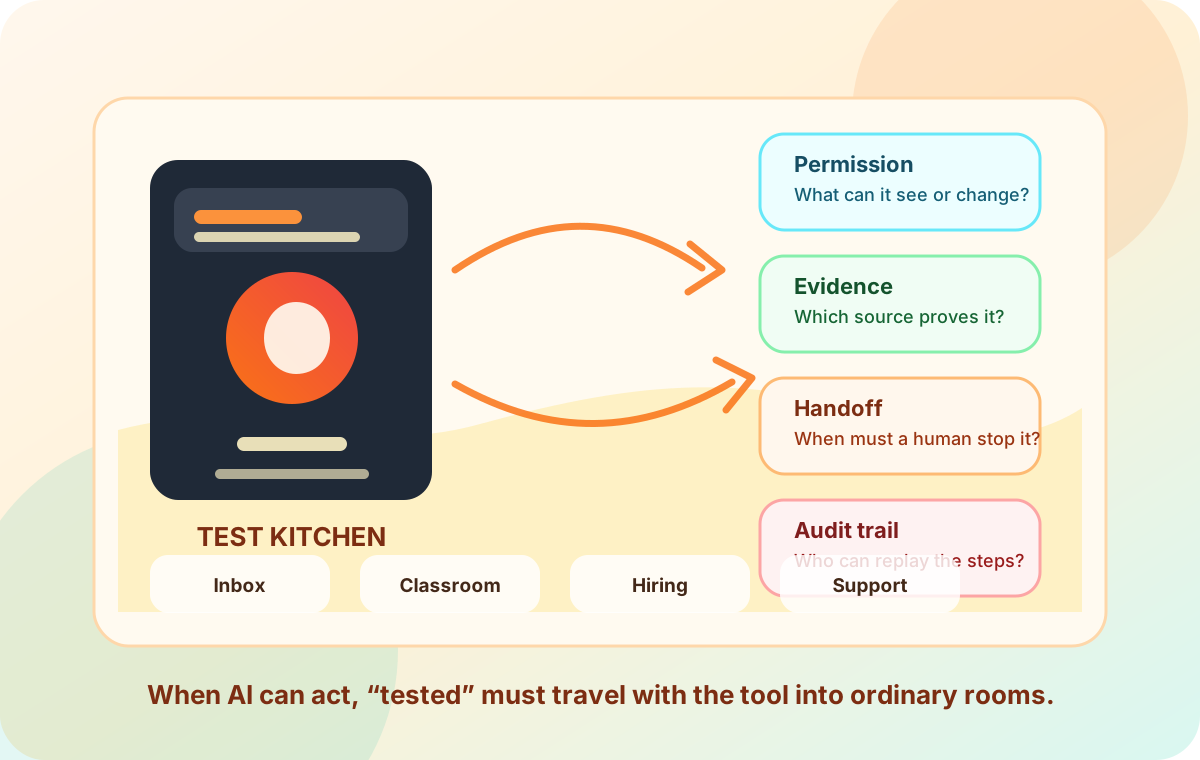
As AI agents move from answers to actions, safety checks must travel with the workflow, not stay behind in a model test room.
Before trusting an agent, ask what it can see, what it can change, where it pauses for a person and whether the action can be replayed later.
A chatbot answer is a statement. An AI agent is a system with a to-do list.
That difference sounds technical, but it is the difference between a recipe card and a kitchen assistant who can open cupboards, spend money, email guests and put the meal on the table. Once AI moves from suggesting to acting, the safety question has to move too.
The current signal is that frontier-model testing is becoming more formal. NIST’s U.S. AI Safety Institute, CAISI, announced May 2026 agreements for pre-release national-security testing of frontier AI models. That matters because evaluation is moving upstream, before a model lands inside products millions of people use.
But the Boiling Frogs question is downstream: what happens after the model leaves the test room and becomes a button in an inbox, browser, coding tool, school platform, customer-support queue or council workflow?
The quiet jump: from answer to authority
Most people first met generative AI as an answer box. You typed, it replied, and the risk was mostly about accuracy, bias, privacy, source quality or over-trust.
Agentic AI adds borrowed authority. The system may browse, compare, draft, file, book, code, escalate, message or change a record. The user may still feel in charge because the interface is calm. Under the surface, the tool is walking through permissions that used to belong to a person.
That is why “it was tested” is not enough on its own. Tested for what? In which version? With which tools connected? Under whose permissions? With what pause points? In what real-world setting?
Four checks that need to travel with the agent
Think of agent safety like a label on food. It is useful only if it stays attached from factory to kitchen to plate.
| Check | Plain-English question | Everyday example |
|---|---|---|
| Permission | What can it see or change? | A browser agent can read a school portal, but can it submit a form or change a payment method? |
| Evidence | Which source proves the action is sensible? | A support agent offers a refund: did it cite the policy, the order history and the exception rule? |
| Handoff | When must a human stop and decide? | A hiring tool drafts a shortlist: at what confidence, bias flag or missing-data point does a person intervene? |
| Audit trail | Who can replay what happened? | A calendar agent books a meeting with a client: can the team see the prompt, sources, edits and final action? |
Without those checks, the risk is not a dramatic robot takeover. It is something quieter: a workflow where everyone assumes someone else understood what the system did.
Why this is a now story
Three signals are converging.
First, testing is moving earlier. The CAISI/NIST announcement shows that governments and labs are treating pre-release evaluation as part of the supply chain, not a public-relations afterthought.
Second, AI is spreading task by task. Anthropic’s Economic Index found AI use showing up across at least a quarter of tasks in 36% of occupations. That is the frog-water pattern: the job title stays familiar while drafts, summaries, comparisons, triage and first-pass analysis quietly change hands.
Third, the infrastructure is becoming heavy. The IEA’s 2025 Energy and AI report frames data-centre demand as a real physical build-out. Agentic AI will not only answer more questions; it may run longer workflows, call tools and depend on more cloud infrastructure behind the curtain.
Put together, the everyday implication is simple: AI safety is no longer only a model-card issue. It is a workflow issue.
A household test for the next agent demo
When you see a demo of an AI agent doing something impressive, try this four-part translation.
- What did it read? Emails, documents, browsing history, customer records, code, school data, payment pages?
- What did it change? Did it only draft, or did it send, file, buy, book, rank, delete, approve or escalate?
- Where did it pause? Did a human approve the risky step, or only admire the final result?
- What proof remains? Could someone inspect the sources, prompt, decision path and final action later?
That turns a flashy demo into a practical safety conversation.
The Boiling Frogs lens
The hot water is not “AI will do everything tomorrow.” It is that small delegations become normal before their guardrails become visible.
A family lets a tool summarise homework. A manager lets it draft performance notes. A council lets it triage cases. A founder lets it browse, compare suppliers and send emails. Each step feels convenient. The question is whether permission, evidence, handoff and audit travelled with the convenience.
That is the sharper way to read agentic AI news: not “can it act?” but “who remains responsible when it does?”
Watch next: whenever a product says it has agent features, look for the boring controls. They are the story: scopes, logs, approval gates, source trails, rollback, escalation and human accountability.
Sources: NIST / CAISI frontier AI testing agreements, Anthropic Economic Index, IEA Energy and AI 2025.